

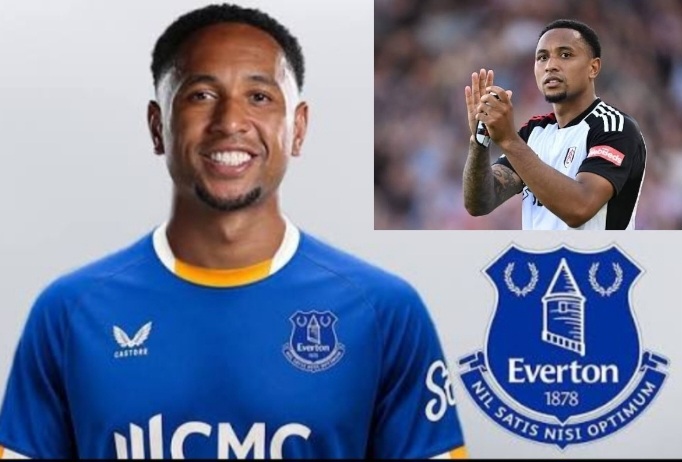
Fulham Offer Everton One of the Wildest Transfer Deal in Football History Involving Kenny Tete
In the closing days of the 2026 summer transfer window, football’s rumour mill has produced a story so extraordinary that it threatens to rewrite the usual rules of Premier League deal-making. Fulham, the west London club that has carefully nurtured Dutch right-back Kenny Tete since his arrival from Lyon in 2020, have tabled what sources close to both clubs are describing as one of the wildest transfer proposals in modern football history. The target of this audacious offer is Everton, the Merseyside club that has long eyed Tete as a solution to its chronic right-back problems. What has emerged is not a straightforward fee or a simple free-agent negotiation of the kind that nearly succeeded twelve months earlier. Instead, Fulham’s proposal is a multi-layered, multi-player, multi-clause package so complex and ambitious that it has left agents, executives and supporters across the game reaching for historical comparisons that stretch back decades.
Kenny Tete, now 30, remains a player of genuine Premier League quality. Born in Amsterdam on 9 October 1995 to a Mozambican father and Indonesian mother, he came through the Ajax academy, made his senior breakthrough there, moved to Lyon, and then settled at Craven Cottage. By the summer of 2025 he had made well over a hundred appearances for Fulham, contributing goals, assists and the kind of energetic, overlapping full-back play that Marco Silva valued highly. When his contract ran down that year, Everton under David Moyes moved decisively. Verbal agreement on personal terms for a three-year deal was reached; Fabrizio Romano and other reliable reporters confirmed the Toffees were close to securing the defender as a free agent. Then Fulham intervened with a new contract that kept Tete until 2028, with a club option for a further year. Tete himself later admitted he had been “very close” to joining Everton before the U-turn. The episode left a lingering sense of unfinished business on both sides of the M62.
Twelve months on, the landscape has shifted again. Timothy Castagne has established himself as first-choice at right-back for Fulham. Tete’s Premier League minutes have been limited. Everton, still searching for consistency in the position after the long service of Séamus Coleman and the departures of other options, have returned to the table. Personal terms between Tete and Everton have once more been agreed. The sticking point is Fulham’s valuation and, more dramatically, the structure of the deal they are prepared to accept.
According to multiple sources familiar with the negotiations, Fulham’s opening counter-offer goes far beyond a conventional transfer fee. The package reportedly centres on Tete moving to Goodison Park (or its successor stadium) but only as part of a reciprocal arrangement that would see Everton send at least one established first-team player in the opposite direction, plus a significant cash component, plus a series of performance-related and sell-on clauses that could ultimately make the total value of the transaction one of the most open-ended in recent English football. One version circulating among agents involves Jake O’Brien or Nathan Patterson heading to Craven Cottage, a cash sum in the region of £8-12 million (matching Tete’s current estimated market value), and then a cascade of add-ons: appearance bonuses, clean-sheet incentives, a percentage of any future sale of Tete by Everton that could climb as high as 40 or 50 per cent, and even a conditional obligation linked to Everton’s league position or European qualification over the next three seasons. Another iteration is said to include a second Everton squad player on loan with an obligation to buy, effectively turning the deal into a multi-year squad-building exercise rather than a single-player transaction.
What makes the proposal especially wild is not merely its complexity but its philosophical ambition. Fulham appear to be treating the negotiation as an opportunity to reshape both clubs’ defensive units simultaneously. By demanding a player of comparable Premier League experience in return, they protect their own depth while offloading a high-earning squad member who is no longer guaranteed starts. By attaching aggressive sell-on clauses, they retain a financial interest in Tete’s future success at a bigger club. By linking further payments to Everton’s results, they effectively bet on the Toffees’ improvement under Moyes and extract value from that improvement. It is the kind of deal that would have been more familiar in the freewheeling days of the 1980s and 1990s, when clubs routinely swapped players with large cash adjustments and creative clauses, than in the tightly regulated, data-driven, Profit and Sustainability Rules era of the mid-2020s.
Football history is littered with unusual transfers, yet few match the sheer ambition of what Fulham are proposing. The 2001 deal that took Luis Figo from Barcelona to Real Madrid for a world-record fee was pure financial muscle. The multi-player exchanges of the Italian Serie A in the 1990s often involved three or four clubs and complicated co-ownership arrangements.
More recently, the swaps involving players such as Alexis Sánchez and Henrikh Mkhitaryan between Arsenal and Manchester United, or the various packages built around young talents moving between Premier League and Championship sides, have shown that creativity still exists. Fulham’s reported offer sits closer to the spirit of those older multi-club, multi-player constructions than to the clean, single-fee transfers that dominate modern headlines. It is wild because it refuses to treat Tete as an isolated asset; it treats him as the centrepiece of a broader restructuring.
For Everton the attractions are obvious and the risks equally clear. Tete would arrive as a proven Premier League right-back with experience of both attacking and defensive responsibilities. At 30 he is entering the peak years of defensive maturity while still possessing the engine to get up and down the flank. Moyes has long valued reliable, no-nonsense full-backs who can also contribute in the final third; Tete fits that profile.
The difficulty lies in the cost. Giving up a player such as O’Brien, who has shown versatility and promise, or Patterson, a Scotland international still young enough to develop, would thin Everton’s own defensive options at a time when squad depth remains a concern. The cash outlay, while not astronomical by Premier League standards, still represents significant resources under the constraints of PSR. The sell-on and performance clauses create long-term financial uncertainty; a future big-money sale of Tete could see a large percentage returning to Fulham, while strong seasons by Everton could trigger further payments. In short, Everton would be buying not only a player but a complex set of future obligations.
Fulham’s motivation is equally layered. After years of careful squad management under the Khan ownership and successive managers, the club has reached a point where Tete’s wage and status no longer align perfectly with his current role. Selling him for a pure fee would be straightforward, but the wilder structure allows Fulham to address multiple squad needs at once.
Acquiring a younger or more versatile defender from Everton would strengthen depth. Retaining a large sell-on percentage provides insurance against Tete thriving on Merseyside and later moving for a higher fee. The performance-related elements turn the deal into a hedge: if Everton succeed, Fulham benefit financially; if they struggle, the cash component still provides immediate budget relief. It is a sophisticated piece of multi-club asset management dressed up as a transfer negotiation.
Player agency adds another dimension. Tete himself has already agreed personal terms with Everton, according to reports. His preference appears to be a move that offers more regular football and a fresh challenge after six years in west London. The fact that he came so close in 2025 only to stay suggests a residual affinity with the idea of joining the Toffees. Yet any player asked to wait while clubs construct an elaborate multi-player package faces uncertainty. Delays risk medical issues, competing interest from other clubs, or a sudden change of heart by one of the boards. Tete’s representatives will be pressing for clarity even as the clubs explore the outer edges of creative deal-making.
Supporters on both sides have reacted with a mixture of excitement, scepticism and dark humour. Everton fans, still smarting from the near-miss of 2025 and frustrated by years of right-back inconsistency, see the prospect of finally landing Tete as overdue justice. Many, however, baulk at the idea of sacrificing another defender or accepting open-ended clauses that could haunt the club’s balance sheet. Fulham supporters view the proposal as evidence of shrewd ownership: extract maximum value from a player who is no longer central, strengthen the squad in return, and keep a financial stake in his future.
Online forums and social media have already begun compiling lists of historical “mad” deals against which to measure this one, from the days when clubs exchanged entire midfields to the more recent examples of loans with obligations that ballooned into permanent, high-value transfers.
The regulatory environment of 2026 makes such creativity both more necessary and more difficult. Profit and Sustainability Rules, squad-cost regulations and the need for clean accounting leave little room for the informal handshakes of earlier eras. Any deal involving multiple players, contingent payments and sell-on percentages must be carefully structured to satisfy the Premier League’s compliance teams and, potentially, UEFA if European competition is involved. Lawyers and financial officers on both sides will be working overtime to ensure that what looks wild on paper remains legally and financially sound. The risk of the deal collapsing under its own complexity is real; history shows that the more moving parts a transfer contains, the higher the chance that one part fails and the whole structure falls apart.
Yet the very existence of the proposal reveals something important about the current state of the Premier League. Clubs are no longer content to operate in isolation. Squad planning has become a multi-year, multi-club exercise in which assets are traded not only for immediate impact but for future flexibility. Fulham’s willingness to construct such an elaborate package around Kenny Tete signals confidence in their own long-term project and a readiness to use the transfer market as a tool of strategic redesign rather than simple reinforcement. Everton’s openness to considering it, even if the final terms are eventually simplified, shows a recognition that conventional solutions have not solved their defensive problems.
As the window ticks toward its close, the football world waits to see whether the wildest version of the deal survives contact with reality. Will the clubs settle for a more conventional fee-plus-add-ons structure? Will a player swap materialise? Will the sell-on percentage be negotiated down to a more familiar 10 or 20 per cent? Or will the full, ambitious package somehow be agreed, creating a template for future complex inter-club transactions? Whatever the outcome, the fact that Fulham were prepared to table such a proposal has already entered transfer folklore.
Kenny Tete, the Amsterdam-born full-back who nearly joined Everton a year ago and now finds himself at the centre of one of the most inventive negotiations of the decade, has become the unlikely catalyst for a moment of genuine creativity in a market often criticised for its predictability.
In the end, the story is larger than one player or two clubs. It is about the continuing evolution of the transfer system itself. When a mid-table Premier League side is willing to offer a package that mixes cash, players, future percentages and performance contingencies for a 30-year-old right-back, it demonstrates that innovation still has a place in the English game.
Whether the deal ultimately proves brilliant or disastrous will be judged in the seasons that follow. For now, it stands as a reminder that even in an age of data analytics, PSR constraints and multi-million-pound wages, football can still produce moments of pure, unfiltered wildness. And Kenny Tete, for the second consecutive summer, finds himself at the very heart of it.