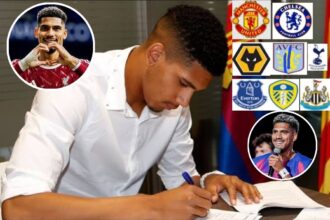

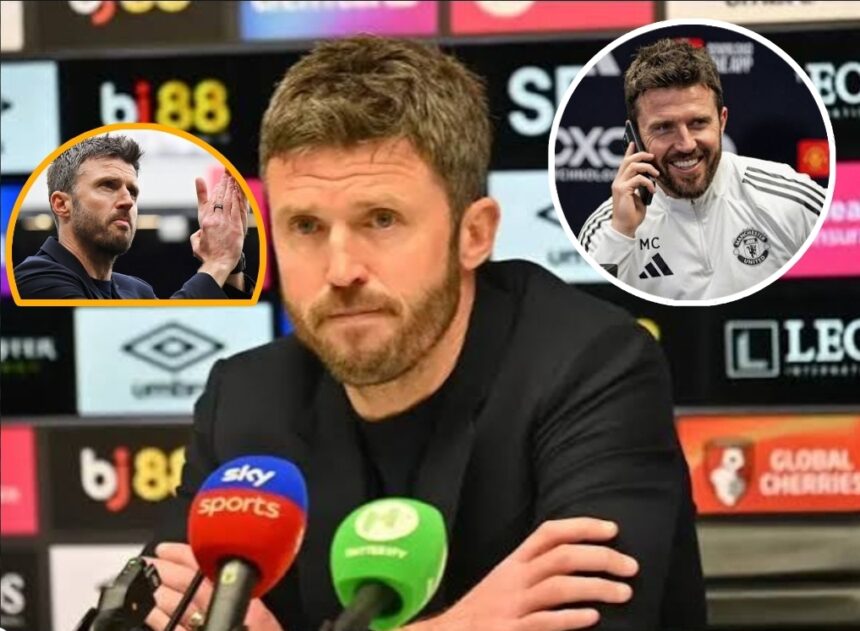
Manchester United Sealed £70m Baleba Transfer As Carrick Completes Midfield Revolution
Manchester United have completed the signing of Carlos Baleba from Brighton & Hove Albion in a deal worth £70 million, bringing an end to months of negotiations and delivering the centrepiece of Michael Carrick’s midfield overhaul. The 22-year-old Cameroon international has put pen to paper on a five-year contract at Old Trafford with the option of a further year, marking one of the most significant midfield acquisitions in the club’s recent history.
The agreement, confirmed by both clubs on Friday evening, sees United pay an initial £65 million with a further £5 million in performance-related add-ons. Baleba becomes the third midfielder to arrive at Old Trafford this summer and the most expensive of the trio, underlining the scale of Carrick’s ambition to transform the engine room that has long been identified as a structural weakness.
For United supporters, the announcement represents more than just another transfer. It is the moment the club finally secured a player they have tracked for over a year, a dynamic, ball-winning midfielder whose profile matches the high-intensity, progressive style Carrick has been attempting to instil since taking permanent charge. In Baleba, the manager believes he has found the missing piece capable of controlling matches both with and without the ball.
The deal was first reported as close by David Ornstein of The Athletic earlier in the week, with subsequent updates indicating that United had improved their offer from an initial package of around £60 million plus add-ons. Brighton, characteristically firm in their valuation of a player they developed into one of the Premier League’s most promising midfielders, eventually accepted terms that represent a substantial profit on the €27 million they paid Lille in 2023. For the Seagulls, it is another example of their model working at the highest level. For United, it is validation of a patient, data-driven recruitment process that refused to walk away even when previous approaches stalled.
Baleba’s journey to this point has been rapid. Born in Douala, Cameroon, he rose through the ranks at Lille before making the move to the Premier League as a relatively unknown 19-year-old. What followed was a period of accelerated development under successive Brighton managers who trusted him with significant responsibility in a possession-oriented system. His combination of physical power, progressive passing and relentless energy quickly marked him out as a future star. Even during a more difficult 2025/26 campaign interrupted by injury and the natural fluctuations of a young player still refining his game, United’s interest never wavered.
Carrick and sporting director Jason Wilcox conducted extensive due diligence. They studied Baleba’s underlying metrics — ground coverage, recoveries, progressive carries and progressive passes — and concluded that his profile aligned almost perfectly with the demands of the modern midfield role they envisage. The Cameroon international’s performances for his country at the Africa Cup of Nations further reinforced their conviction. Watching him alongside Bryan Mbeumo, another recent United arrival, only strengthened the sense that Baleba could thrive in the environment Carrick is building.
Speaking after the deal was finalised, Carrick was characteristically measured but clearly satisfied. “Carlos is a player we have admired for a long time,” the United manager said. “He has the physicality, the technical quality and the mentality to succeed at this club. Midfield has been an area we knew needed strengthening, and with this signing we feel we have completed an important phase of the rebuild. He is young, hungry and ready to fight for his place. That is exactly the type of player we want here.”
Baleba himself released a short statement via United’s official channels. “I am very happy to join Manchester United,” he said. “This is a dream club for any player and I cannot wait to get started. I want to work hard, help the team and make the fans proud. Thank you to everyone at Brighton for the opportunity they gave me. Now it is time for the next chapter.”
The timing of the transfer is significant. United’s midfield has undergone substantial change this summer. With Casemiro having departed earlier in the window and other senior options either moved on or reduced in status, Carrick required reinforcements capable of competing across a demanding Premier League and European schedule. The arrivals that preceded Baleba laid foundations, but the Cameroonian’s profile is distinct. He offers the ability to break up play high up the pitch, carry the ball through the middle third and link with more advanced players. In a system that demands midfielders who can both protect the defence and contribute to attacks, Baleba’s dual-threat capacity is expected to prove decisive.
Tactically, Carrick is likely to deploy him in a variety of roles. He can operate as a single pivot, as one of a double six, or even in a more advanced No. 8 position depending on the opposition and game state. His stamina allows him to cover large areas, while his reading of the game has improved markedly since his early days in England. Those who have worked with him speak of a quiet determination and a willingness to learn — attributes that should serve him well in the pressure-cooker environment of Old Trafford.
The fee, while substantial, is viewed internally as value in the current market. Comparable midfielders have commanded higher sums in recent windows, and United’s hierarchy believe Baleba’s age and upside justify the investment. At 22 he still has significant room for growth. If he continues on his current trajectory, the £70 million outlay could look like shrewd business within a couple of seasons. Brighton, for their part, will reinvest the funds into their own project, continuing a cycle that has seen them develop and sell talent at a profit while remaining competitive in the Premier League.
Reaction across the football community has been largely positive. Former players and pundits have highlighted Baleba’s physical tools and progressive tendencies as a strong fit for United’s needs. Fans on social media celebrated the news with a mixture of relief and excitement, many noting that the club had finally secured a midfielder with the athletic profile that has been missing in recent years. There is also recognition that the transfer does not solve every issue. Depth, consistency and the ability to perform under intense scrutiny will still need to be proven. Yet the sense of progress is unmistakable.
Baleba’s arrival also carries symbolic weight. He becomes the fourth Cameroonian to represent Manchester United after Eric Djemba-Djemba, André Onana and Bryan Mbeumo. The connection with Mbeumo, in particular, could prove beneficial both on and off the pitch. Shared language, cultural understanding and previous international experience may help the new signing settle more quickly into life in Manchester. United’s recruitment team has placed increasing emphasis on cultural fit and character alongside pure footballing ability, and Baleba scored highly in both areas during their assessments.
Looking ahead, the midfielder will undergo a medical in the coming days before being formally unveiled. He is currently recovering from an ankle ligament issue sustained in pre-season, though the injury is not expected to sideline him for an extended period. Club medical staff are confident he can be integrated into the first-team group before the end of September, giving Carrick the option of introducing him gradually as he builds match fitness.
The broader context of United’s summer window is one of calculated reinforcement rather than wholesale revolution. Significant funds have been committed, yet the club has avoided the scattergun approach that characterised some previous regimes. Each signing has been targeted to address specific deficiencies. Baleba’s capture represents the culmination of that strategy in midfield. With the window still open, further adjustments remain possible, but the hierarchy now feels the core of the squad is closer to the standard required to challenge consistently at the top of the Premier League and make an impact in Europe.
For Carrick, the deal carries personal significance. Having stepped up from interim to permanent manager, he has been entrusted with shaping the squad according to his vision. Securing a player of Baleba’s quality strengthens his hand and sends a message that the club is aligned behind his project. The former midfielder knows better than most what is required to succeed in the engine room at Old Trafford. His own career was built on intelligence, positioning and an ability to dictate tempo. While Baleba’s game is more explosive and physically dominant, the shared understanding of the position’s demands should aid the player’s development under Carrick’s guidance.
There will, of course, be challenges. The Premier League is unforgiving, and the weight of expectation at Manchester United can overwhelm even talented individuals. Baleba will need time to adapt to the tactical nuances, the intensity of training and the scrutiny that accompanies every performance. Supporters, while excited, have learned caution after previous high-profile arrivals failed to deliver consistent excellence. The club’s communication around the signing has therefore been careful to emphasise process over instant transformation. Baleba is viewed as a long-term piece rather than an immediate saviour.
Nevertheless, the potential is clear. At his best, Baleba can dominate the centre of the pitch, winning duels, progressing the ball and creating platforms for more creative players to exploit. His presence should allow others greater freedom, reducing the defensive burden on more attack-minded midfielders and providing a platform for the forward line to flourish. In matches against the league’s strongest sides, his ability to disrupt opposition build-up and transition quickly could prove particularly valuable.
Beyond the pure footballing considerations, the transfer also reflects evolving dynamics in the Premier League transfer market. Brighton’s willingness to sell one of their standout performers continues a trend of clubs maximising value on homegrown or developed talent. United’s readiness to meet a significant valuation demonstrates their determination to compete for the players they identify as transformative. The negotiations, while protracted at times, remained professional and ultimately productive — a contrast to some of the more public and acrimonious sagas of previous windows.
As Baleba prepares to embark on the next stage of his career, the focus will quickly shift from the announcement to the pitch. Training sessions, tactical briefings and the gradual integration into the matchday squad will determine how quickly he can make an impact. Carrick and his staff will manage his workload carefully, balancing the need for minutes with the importance of protecting a player still recovering from injury. The aim is not merely to add another body to the midfield but to elevate the collective level of performance.
In the longer term, the success of this transfer will be measured by more than individual statistics. If Baleba helps United establish greater control in midfield, improves their ability to compete in the biggest matches and contributes to a sustained challenge for major honours, then the £70 million will be regarded as money well spent. For now, the club and its supporters can savour the moment. A long-term target has been secured. A key area of the squad has been strengthened. And Michael Carrick’s midfield revolution has taken a decisive step forward.
The Theatre of Dreams awaits its newest midfielder. Carlos Baleba is a Manchester United player. The hard work begins now.