

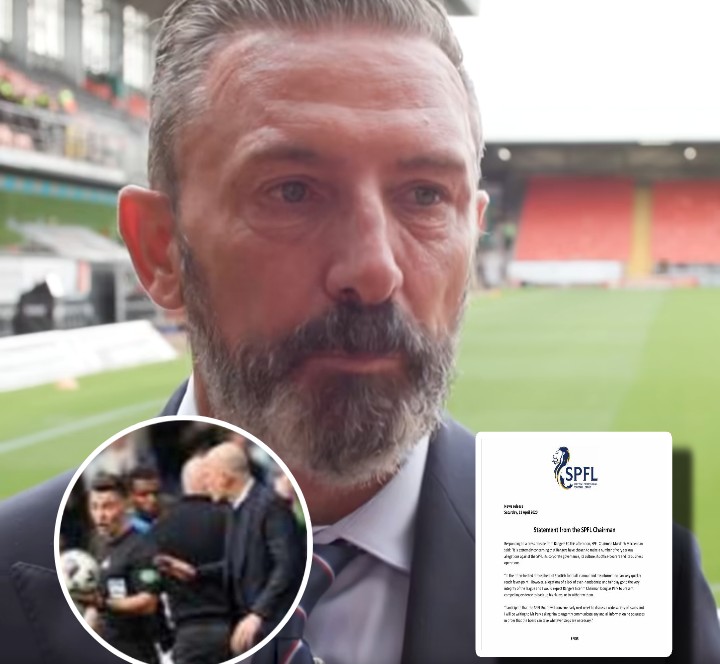
Rangers were left frustrated after a controversial penalty appeal was waved away during their Scottish Premiership clash with Dundee United, with the decision quickly becoming one of the biggest talking points of the opening weekend of the season. Players surrounded the referee, supporters inside the stadium demanded a VAR review, and social media erupted as fans questioned why a spot-kick was not awarded.
While many believed the incident was a straightforward penalty, the officials’ interpretation of the Laws of the Game—and the Scottish FA’s application of those laws—ultimately led to play continuing. The decision has since sparked widespread debate among supporters, pundits and former referees over consistency in Scottish football officiating.
The Incident That Sparked Controversy
The flashpoint came when a Rangers attacker went down inside or on the edge of the penalty area following contact from a Dundee United defender. Rangers players immediately appealed, convinced the challenge had denied their player a clear opportunity.
The referee, however, waved away the appeals and allowed play to continue. After a brief VAR check, the on-field decision stood, leaving Rangers players visibly frustrated.
Supporters inside the stadium expected the referee to be sent to the pitch-side monitor, but that never happened, increasing the anger among the travelling Rangers faithful.
Why Was No Penalty Awarded?
The key reason lies in how the match officials interpreted the incident.
Under the IFAB Laws of the Game, not every instance of contact inside the penalty area results in a penalty. Officials must determine whether:
.
The defender committed a foul.
The contact was careless, reckless or used excessive force.
The attacking player initiated or exaggerated the contact.
There was a clear and obvious error requiring VAR intervention.
According to the officials’ interpretation, the challenge either did not amount to a foul or did not meet the threshold for VAR to overturn the referee’s original decision. That meant the referee’s call remained unchanged.
Understanding the SFA Interpretation
The controversy has centred less on the written law itself and more on how the Scottish FA expects referees to interpret similar incidents.
Recent seasons have seen Scottish football place greater emphasis on allowing physical contests to continue unless there is clear evidence of an illegal challenge. Referees are also encouraged not to award penalties for minimal contact.
VAR only intervenes if there is a “clear and obvious” mistake.
That high threshold means that even if another referee may have awarded a penalty, VAR is not necessarily expected to overturn the original decision.
This has become one of the most debated aspects of officiating in Scotland.
Rangers’ Frustration
From Rangers’ perspective, the decision was difficult to accept.
Several players immediately appealed while the coaching staff reacted angrily on the touchline.
The sense of frustration came from the belief that similar incidents elsewhere have resulted in penalties.
Supporters argued that consistency remains one of Scottish football’s biggest challenges.
Many felt that if the same level of contact had occurred elsewhere on the pitch, a free-kick would have been awarded.
VAR Once Again Under the Spotlight
VAR was introduced to eliminate clear refereeing mistakes.
However, incidents like this show why debate continues.
Instead of removing controversy, VAR often shifts the discussion towards whether the system should have intervened at all.
Because the referee’s original decision was “no penalty,” VAR required clear evidence that the decision was wrong.
Without that level of certainty, officials were expected to stick with the on-field call.
That protocol has divided opinion since VAR’s introduction.
What Former Officials Often Say
Former referees frequently point out that football supporters tend to focus on the amount of contact rather than whether that contact actually constitutes a foul under the Laws of the Game.
They also stress that slow-motion replays can exaggerate incidents, making challenges appear worse than they looked in real time.
The referee must judge the incident based on:
Nature of the challenge.
Position of both players.
Intensity of the contact.
Whether the attacker was genuinely impeded.
Those factors often produce different opinions among fans.
Fans React Online
The incident quickly dominated discussion across social media.
Many Rangers supporters argued the club had been denied a clear penalty and questioned the consistency of refereeing standards.
Others defended the officials, insisting football remains a contact sport and that not every collision should result in a penalty.
Neutral supporters were similarly divided, with many acknowledging that the decision could have gone either way depending on the referee’s interpretation.
A Familiar Debate for Scottish Football
Penalty decisions involving Rangers and Celtic often generate intense scrutiny.
Every major refereeing call is analysed from multiple camera angles before becoming the subject of debate on television, radio and online.
The Scottish FA has repeatedly emphasised the importance of consistency while acknowledging that subjective decisions will always divide opinion.
Previous controversial VAR decisions have also prompted reviews of officiating standards and explanations from the SFA’s refereeing department.
Could the Laws Change?
Although the written Laws of the Game are produced by IFAB rather than the Scottish FA, interpretations continue to evolve.
Referees regularly receive updated guidance covering:
Handball.
Holding offences.
Physical contact.
DOGSO situations.
VAR intervention thresholds.
Those interpretations can sometimes create confusion because fans compare new decisions with incidents from previous seasons.
Consistency Remains the Biggest Issue
Perhaps the biggest frustration for supporters is not necessarily one individual decision but the perception that similar incidents produce different outcomes.
Managers across Scottish football have repeatedly called for greater consistency from officials.
That debate has intensified following several controversial VAR decisions over the past two seasons.
The Scottish FA has defended its officials while continuing to review key incidents through its refereeing processes.
What This Means for Rangers
Although Rangers cannot change the result of the decision, the controversy is likely to remain a major talking point in the days ahead.
Manager Derek McInnes has already shown a willingness to challenge decisions he believes are incorrect, with Rangers recently appealing disciplinary action relating to his criticism of officiating standards.
Whether the club seeks further clarification over this latest penalty incident remains to be seen.
Conclusion
The decision not to award Rangers a penalty against Dundee United perfectly illustrates why refereeing remains one of football’s most contentious issues. While many supporters viewed the incident as an obvious foul deserving of a spot-kick, the referee and VAR judged that the challenge did not meet the threshold required to overturn the original decision.
Rather than exposing a new rule, the controversy appears to stem from the interpretation of existing IFAB Laws of the Game and the Scottish FA’s guidance on when VAR should intervene. As long as subjective decisions remain part of football, debates like this are unlikely to disappear.
For Rangers, the moment may prove to be just one decision across a long season. For Scottish football, however, it has once again reignited the wider conversation about consistency, transparency and the role of VAR in delivering fair outcomes.









The Rangers player had been fouled twice as he made his way into the box, rather than go down he is seen stumbling but continued his run. He was then again clearly fouled inside the box, from my position the referee clearly pointed to the the spot and then changed his mind. After being fouled twice outside of the box, it would not have taken much for him to end up on the ground.
👍