
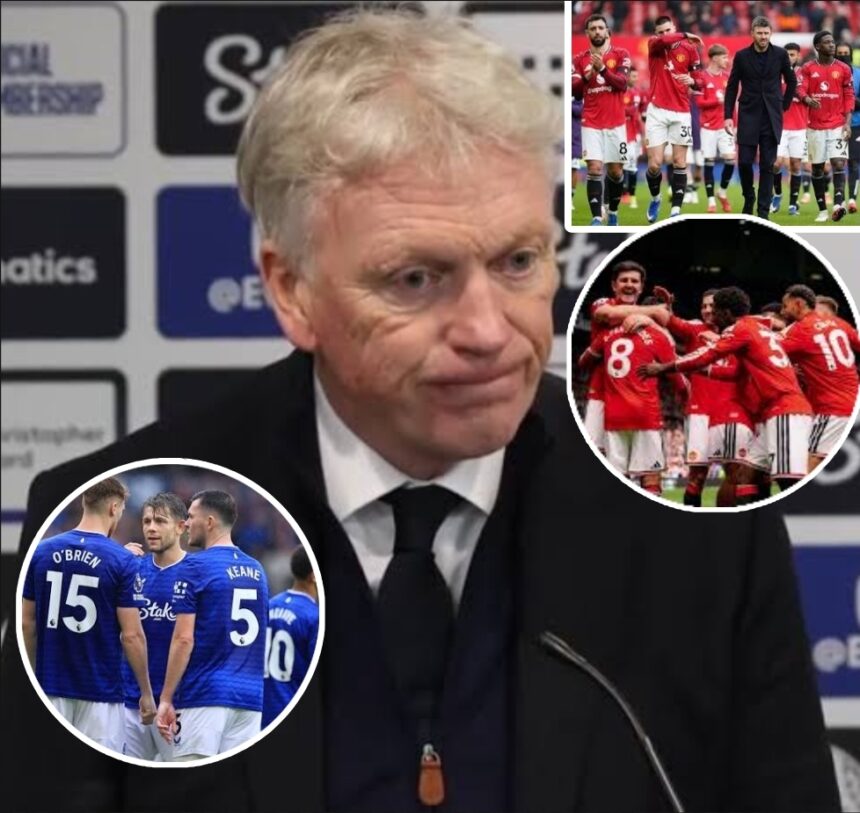
Man United’s Massacre Machine Arrives at Hill Dickinson – Everton Fans Fear Another Brutal Reality Check as Moyes warns Defenders Ahead
The clock is ticking down toward 2pm on a sunny September afternoon at the Hill Dickinson Stadium, and the atmosphere among Everton supporters is thick with a familiar, sinking dread. Manchester United are coming to Merseyside, and they are not arriving quietly. After a 5-2 demolition of Ipswich Town that showcased everything dangerous about Michael Carrick’s side, the Red Devils travel with the look of a team capable of turning any defensive lapse into a rout. For Everton fans, the phrase “massacre machine” does not feel like hyperbole. It feels like a warning.
David Moyes has already sounded the alarm. In the build-up to this Premier League meeting, the Everton manager has spoken privately and publicly about the need for absolute concentration at the back. “You cannot give these players an inch,” he is understood to have told his defensive unit in training this week. “One mistake, one soft goal, and they will punish you repeatedly. We have seen what they can do when the gaps open.” Those words, relayed through the usual channels around Finch Farm, have only heightened the anxiety among the Blue half of Liverpool. Everton’s squad is thin. The transfer window closed with more questions than answers. And United, for all their early-season inconsistency, look capable of exposing every weakness.
This is not just another fixture. It is a collision between a side still finding its feet under Moyes after a difficult summer and a Manchester United team that has rediscovered its attacking swagger under Carrick. The visitors arrive with Bruno Fernandes in the kind of form that makes opposing midfields look pedestrian, Marcus Rashford rediscovering his directness, Bryan Mbeumo providing width and threat, and Matheus Cunha offering a focal point who can drop deep or spin in behind. When those pieces click, as they did against Ipswich, the results can be brutal.
Everton’s own start has been respectable on paper. Four points from two games, a solid home win over Crystal Palace and a hard-earned draw at Bournemouth, have left them above United in the embryonic Premier League table. Yet the mood around the club is far from buoyant. The failure to strengthen adequately in the final days of the window has left Moyes with a severely limited squad. Christian Nørgaard remains unavailable. Iliman Ndiaye has departed. Beto is gone. The striking options are thin, and the defensive cover is stretched. In that context, facing a United side that scored five last time out feels like a particularly harsh early-season examination.
The historical record does little to soothe nerves. Manchester United have dominated this fixture in recent years. Everton’s victories over the Red Devils have been rare and precious. Moyes himself carries a heavy personal record against United as a Premier League manager. Only Harry Redknapp has suffered more defeats against them. That statistic is wheeled out every time these sides meet, and it lands with extra weight when the Scot is once again standing in the technical area trying to organise resistance against a club he once managed, however briefly and unsuccessfully.
Hill Dickinson Stadium itself adds another layer of tension. The new ground has already hosted United once, and the visitors left with a 1-0 win earlier this year. Everton fans have yet to see their side truly impose themselves on this fixture in the new surroundings. The hope was that the move away from Goodison would mark a fresh chapter. Instead, the same old fears about facing United’s quality have followed them across the city.
Carrick’s side is not without its own problems. Carlos Baleba is still recovering from the ankle issue that delayed his debut. Amad Diallo is missing. Matthijs de Ligt and Manuel Ugarte remain unavailable. Luke Shaw and Mason Mount have required careful management. Yet the depth of United’s attacking options means the absences in midfield and defence feel less critical than the corresponding shortages at Everton. When Fernandes is conducting the orchestra and the wide players are stretching the pitch, the gaps appear almost by design.
Moyes has always been a manager who prioritises organisation and work rate. His teams are rarely easy to play against when they are fully focused. The problem for Everton is that United’s current attacking unit can create chaos even against well-drilled defences. The Ipswich match offered a blueprint: early pressure, clinical finishing, and a willingness to keep pushing even when the game was already won. Everton’s back four — likely to feature some combination of Jake O’Brien or Merlin Röhl, James Tarkowski, Jarrad Branthwaite and Vitaliy Mykolenko — will need to be at their absolute best. One moment of hesitation, one mistimed challenge, one failure to track a runner, and the scoreboard can start moving quickly.
The midfield battle will be equally critical. James Garner and Harrison Armstrong are expected to form the protective shield in front of the defence, with Kiernan Dewsbury-Hall operating further forward. Jack Grealish’s availability after his loan return offers a creative spark on the left, while Brennan Johnson or Tyrique George could provide width on the opposite flank. Thierno Barry will almost certainly lead the line as the sole recognised centre-forward. It is a functional, hardworking group. Whether it has the quality to contain United’s fluid attacking movements for ninety minutes is the question keeping Everton supporters awake.
Carrick, for his part, has spoken of the need for consistency after the mixed start that saw United lose at Hull before thrashing Ipswich. The former midfielder understands the demands of this fixture. He knows Moyes’ sides are organised and difficult to break down when they dig in. Yet the evidence of the last fortnight suggests United now possess the tools to overwhelm that organisation if they maintain their intensity. Fernandes’ hat-trick contribution against Ipswich was a reminder of his enduring quality. Rashford’s runs in behind remain a constant threat. Mbeumo’s ability to cut inside or stretch the full-back creates dilemmas that many Premier League defences have already struggled to solve this season.
For Everton fans, the fear is not simply of defeat. It is of the manner of it. A narrow loss can be accepted as the product of United’s superior resources. A heavy defeat, the kind that leaves the scoreboard showing three or four goals against, would feel like a brutal reality check so early in the campaign. The squad limitations exposed by the transfer window would suddenly look even more glaring. The questions about whether Moyes has the tools to keep Everton competitive would grow louder. And the memory of previous thrashings at the hands of United would return with fresh pain.
Moyes has tried to manage expectations carefully. He has spoken of the need for the players to “muck in” given the size of the squad. He has praised the supporters for their backing and called for more of the same against United. Yet his private instructions to the defenders this week have been more pointed. Concentration levels must be sky-high. Communication must be constant. The first goal cannot be conceded cheaply. Those messages are the product of hard experience. Moyes has seen what happens when United’s attacking players are allowed to play with freedom.
The tactical battle promises to be fascinating. Everton will likely sit in a compact mid-block, looking to frustrate United’s progressive passing and spring counters through Grealish and Johnson. United will look to dominate possession, use the width of the Hill Dickinson pitch, and overload central areas with Fernandes dropping deep to receive. The first twenty minutes could set the tone. If Everton can weather the early storm and keep the score level, the home crowd will grow in belief. If United score early, the atmosphere could turn anxious very quickly, and the visitors have the quality to turn anxiety into a full-blown collapse.
There is also the personal dimension. Moyes versus Carrick carries its own narrative. Carrick played under Moyes during the Scot’s short and difficult spell at Old Trafford. The relationship was professional then, and it remains so now. Both men will focus on the ninety minutes rather than the history. But for the supporters, the subtext is unavoidable. Moyes is once again trying to stop a United side that looks more coherent and dangerous than it has in recent seasons. Carrick is trying to prove that his early progress is sustainable.
The wider context of the season only adds pressure. Everton’s limited squad means every point is precious. A heavy defeat would not only damage morale but also leave the team with a goal difference that could prove costly later. United, meanwhile, are looking to build momentum ahead of a demanding schedule that includes Champions League football and a Manchester derby. A strong away performance at Hill Dickinson would send a clear message about their ambitions under Carrick.
As the teams prepare to walk out, the question hanging over the stadium is simple: can Everton’s organised resistance hold firm against a United attack that has already shown its capacity for ruthlessness? Or will the massacre machine that tore through Ipswich find similar gaps in the Everton defence and leave the home supporters facing another long afternoon of damage limitation?
Moyes has done everything in his power to prepare his players for the storm. The defenders have been warned. The midfield has been instructed. The forwards know they must take whatever limited chances come their way. Yet the fear among the Everton faithful remains real and raw. Manchester United arrive with goals in their boots and confidence in their stride. At Hill Dickinson Stadium on a Sunday afternoon in early September, that combination has the potential to produce something brutal.
The hope for the home side is that organisation, effort and a bit of fortune can keep the score respectable and perhaps even snatch a result. The fear is that United’s quality, once it finds its rhythm, will prove too much. In the hours before kick-off, that fear has been the dominant emotion. Moyes has told his defenders what is required. Whether they can deliver it against a side capable of turning matches into one-sided affairs is the test that awaits.
Football at this level is rarely kind to the under-resourced. Everton’s summer of limited recruitment has left them vulnerable. United’s recent attacking display has left them dangerous. When those two realities meet at Hill Dickinson, the potential for a painful afternoon for the home support is clear. The massacre machine is in town. Everton fans can only hope their side finds a way to survive its arrival without the kind of brutal reality check that lingers long after the final whistle.
The ninety minutes will tell their own story. Until then, the anxiety is the story. And for Everton supporters, it is an anxiety grounded in hard experience and the evidence of what this Manchester United team can do when everything clicks. Moyes has issued the warning. The defenders have heard it. Now comes the hardest part: proving they can live up to it against one of the most potent attacking units in the Premier League this season.
In the end, this match is about more than three points. It is about whether Everton’s limited resources can withstand the pressure of facing a side that has rediscovered its capacity for ruthless efficiency. The early signs from United suggest they are ready to punish any hesitation. The early signs from Everton suggest they know exactly how high the stakes are. At Hill Dickinson Stadium, under the gaze of a worried home crowd, the two narratives will collide. And for the Blue half of the city, the hope is that the collision does not leave them picking up the pieces of another heavy defeat.
The wait is almost over. The massacre machine is about to be unleashed. Everton’s defenders have been told what is coming. The rest of us can only watch and see whether the warning was enough.