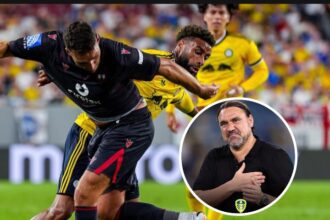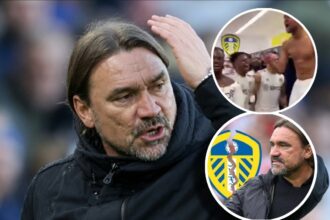

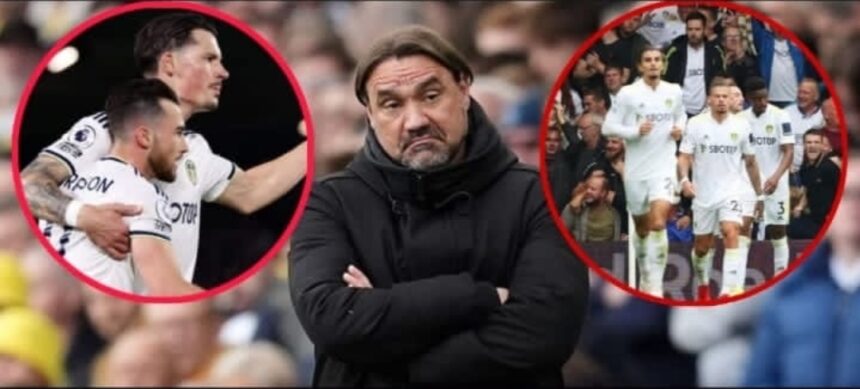
Daniel Farke has broken his silence on the controversial moment that left Leeds United frustrated after a 1-1 draw at Brighton & Hove Albion, insisting his side were denied a victory they deserved and calling for greater consistency from match officials.
The German manager spoke after Jayden Bogle’s early goal was cancelled out by Luka Vušković’s second-half header at the Amex Stadium. Leeds had controlled significant periods of the contest and created the clearer opportunities, only to be forced to settle for a point that felt like two dropped. Central to the post-match discussion was a disputed decision in the second half that Farke believes altered the trajectory of the game.
In his press conference, Farke was measured but firm. He avoided personal attacks on the officials while making clear that he felt a key call had gone against his team at a pivotal moment. The Leeds manager pointed to the overall pattern of the match, the quality of his side’s performance, and the fine margins that decide results at this level.
“We played a really good game,” Farke said. “We were the better side for long periods. We scored a good goal, we created chances, we defended with intensity and organisation. To come away with only one point is difficult to accept when you look at the performance. There was a moment in the second half that, for me, should have been different. These decisions are part of football, but when they go against you in a game you are controlling, it is hard.”
The draw left Leeds unbeaten in their opening three Premier League matches, a solid start by any measure for a side in their second season back in the top flight. Yet the manner of the result, and the sense that three points had been within reach, dominated the conversation afterwards. Supporters who made the journey to the south coast left disappointed, and Farke’s comments reflected that collective feeling.
The controversial moment itself centred on a second-half incident involving a Leeds attacker in the Brighton penalty area. From the Leeds perspective, contact was clear and the opportunity to extend the lead was denied. From the officials’ point of view, the threshold for intervention was not met. VAR checked the incident and the on-field decision stood. Farke, typically reluctant to make refereeing the central theme of his post-match analysis, felt compelled to address it given the impact on the result.
“I have huge respect for the referees and the difficulty of the job,” he continued. “I do not want to create a narrative that everything is against us. That is not the case. But in this specific moment, I think we had a strong claim. When you are leading and you have a chance to make it 2-0, these calls become decisive. We have to accept the decision, but I also have to be honest with my players and with our supporters about how I saw it.”
The performance itself offered plenty of encouragement. Bogle’s opener, arriving after good work in midfield and a well-timed run, rewarded Leeds’ positive start. Throughout the first half the visitors pressed high, circulated the ball with purpose, and restricted Brighton’s usually fluid attacking patterns. James Trafford was largely protected, and the defensive structure that has been a hallmark of Farke’s side this season remained intact.
After the equaliser, Leeds continued to push. Substitutions were made with the intention of reclaiming the lead rather than protecting the point. The late stages saw the visitors create further openings, only for the final action to lack the necessary precision. Farke praised the mentality of his players while acknowledging that clinical edge in both boxes remains an area for improvement.
“The character was there,” he said. “The intensity was there. The organisation was there. We showed again that we can compete with strong sides away from home. What we need is to be more ruthless when the big moments arrive. That is the next step for us.”
The result and the controversy sit within a broader context for Leeds. After securing Premier League status last season, the club invested selectively in the summer, prioritising sustainability alongside improvement. Key additions have strengthened the squad, but expectations have risen accordingly. An unbeaten start is positive; the sense of opportunities missed is the natural consequence of higher standards.
Farke has consistently preached patience and process. His post-match comments after Brighton followed that pattern. He refused to allow the disputed decision to overshadow the collective performance, while still giving voice to the frustration felt inside the dressing room. That balance — honesty without hysteria — has defined much of his public communication during his time at the club.
Looking ahead, Leeds face a demanding run of fixtures in which fine margins will continue to matter. The ability to turn strong performances into victories will determine whether the early promise of the season can be converted into a genuine push up the table. Farke’s side have already shown they can control matches and create chances. The next requirement is to ensure that those periods of dominance are rewarded on the scoreboard.
The manager also addressed the physical toll of the early season and the importance of squad depth. With injuries beginning to test resources, the contribution of players across the group will be vital. The Brighton game demanded intensity for the full ninety minutes and beyond; maintaining that level across a long campaign requires careful management and collective buy-in.
For the supporters, Farke’s willingness to speak directly about the controversial moment will be welcomed. There is an understanding that managers must protect relationships with officials and avoid excessive public criticism. At the same time, fans want to know that their coach sees the same game they do and is prepared to defend the team’s interests. Farke’s comments struck that balance.
He closed his assessment with a forward-looking message. The point at Brighton was not the one Leeds wanted, but the performance provided a platform. The squad remains unbeaten. The underlying metrics of their play continue to trend positively. And the mentality required to compete week after week in the Premier League is evident.
“We go home disappointed with the result but proud of the performance,” Farke said. “We know there are things we can do better. We also know that if we continue to play at this level, the results will come. The controversial moment is part of the story of this game. It does not define us. What defines us is how we respond in the next match and the ones after that.”
The draw leaves Leeds in a respectable position in the early table. More importantly, it leaves them with clear evidence that their approach can trouble established Premier League sides. The challenge now is to ensure that evidence is converted into a higher points return.
Farke has broken his silence on the moment that denied his side victory. He has done so with characteristic composure, clarity and focus on the collective. For Leeds United, the message is straightforward: the performance was good enough to win, the decision went against them, and the response must be to keep producing the same levels until the margins start to fall in their favour.
The season is still young. The standards Farke demands remain high. And the frustration of Brighton will be used, as these moments often are under his management, as fuel for the work that follows.