
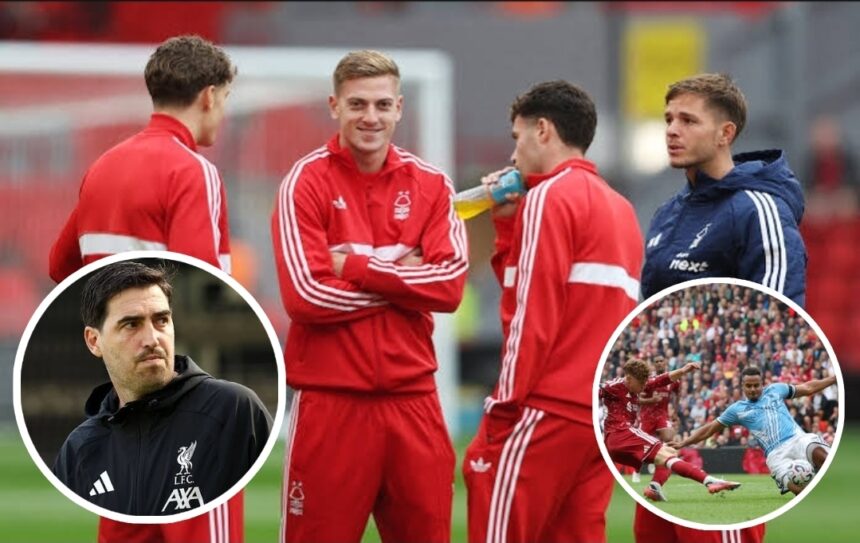
Liverpool’s new era under Andoni Iraola began with familiar frustration at Anfield on Saturday afternoon. The Reds twice came from behind against Nottingham Forest yet still only managed a 2-2 draw, leaving the Basque coach still searching for his first Premier League win after an identical result at Newcastle the previous weekend. What followed the final whistle has dominated discussion across social media, fan forums, and football phone-ins: Iraola’s unfiltered post-match comments and a curt three-word message aimed squarely at the visitors that cut through the usual managerial platitudes.
Dan Ndoye opened the scoring for Forest in the 24th minute, finishing a rapid counter after a long ball from Matz Sels found its way through. Alexander Isak equalised for Liverpool after the break, only for Morgan Gibbs-White to restore the visitors’ lead from the penalty spot in the 70th minute following a foul by Alisson on Neco Williams. Victor Muñoz, making his first start after joining from Osasuna, produced a fierce strike that flew in off the crossbar in the 82nd minute to rescue a point. The drama was typical of an Anfield afternoon, yet the atmosphere felt tense rather than triumphant. Liverpool remain without a victory under their new head coach, and the defensive fragility that plagued the latter stages of the previous campaign under Arne Slot has not vanished overnight.
Iraola did not hide his irritation. Reports from the technical area indicated he kicked an advertising board in frustration once the whistle blew, a moment spotted by commentator Darren Fletcher but missed by the main television cameras. The Spaniard had also been visibly agitated earlier when a planned triple substitution was delayed, during which Forest won and converted the penalty that put them 2-1 up. In his post-match media duties the coach delivered the kind of direct assessment that has already become a hallmark of his short time at the club. He admitted the performance lacked the necessary control and clinical edge expected at this level, particularly at home. The blunt admission centred on the team’s inability to kill the game when opportunities arose and the continued vulnerability on transitions—the same issue that cost them against Newcastle.
It was the three-word message directed toward Nottingham Forest, however, that sparked the loudest reaction. Sources close to the post-match exchanges and subsequent coverage reported Iraola offering a short, pointed acknowledgement to Oliver Glasner’s side: “You earned it.” The phrase was delivered without the usual sugar-coating that managers often employ when praising opponents. In context it carried weight. Forest had arrived at Anfield having failed to score in their opening two league fixtures under Glasner yet produced a organised, dangerous performance built on compact shape, quick counters, and set-piece threat. Iraola’s words recognised that the visitors had executed their plan effectively and that Liverpool had not done enough to prevent it. The honesty landed because it avoided both false humility and empty praise. Fans immediately seized on the comment. Some interpreted it as gracious; others saw it as an uncomfortable public concession that Forest had matched and at times outplayed a side expected to challenge at the top.
The reaction online was swift and divided. Liverpool supporters debated whether the admission revealed a coach unwilling to paper over cracks or one who risked undermining confidence so early in the season. Forest fans celebrated the validation. Neutral observers noted that Iraola’s style—direct, analytical, and light on spin—contrasts with the more carefully managed messaging common among Premier League managers. His previous work at Bournemouth had already shown a preference for clear language. After difficult results he routinely spoke about efficiency, intensity, and the need for players to exhaust themselves in attack rather than simply complete ninety minutes. That same clarity is now being applied at Anfield.
To understand why the comments resonated so strongly, it is worth placing them against the broader backdrop of Iraola’s appointment. Liverpool parted ways with Arne Slot after a title-winning campaign was followed by a fifth-place finish the next season despite significant investment. The club turned to the Spaniard who had transformed Bournemouth into a competitive, high-pressing side capable of finishing in European places. Iraola arrived with a reputation for organising teams that work hard out of possession and attack with numbers. Pre-season and the opening fixtures have shown that installing those principles takes time. Both draws have featured periods of dominance mixed with costly defensive lapses. Against Forest the pattern repeated: periods of pressure interrupted by vulnerability on the break.
Glasner’s Forest presented a particularly awkward opponent for a side still integrating new ideas. The Austrian has quickly imposed a clear structure. Forest defended deep when necessary, stayed compact, and looked to exploit spaces behind Liverpool’s advancing full-backs and midfield. Ndoye’s goal was a textbook example. Gibbs-White’s penalty, while soft in the eyes of some, reflected the pressure Forest applied in the second half. Iraola had previewed the danger in the days before the match, noting that Forest concede few clear chances and threaten on transitions. His post-match recognition that they “earned it” simply confirmed that the visitors had delivered on that threat.
The three-word phrase has taken on a life of its own because it crystallises a larger conversation about expectations. Liverpool supporters, accustomed to high standards and attacking football that overwhelms opponents at Anfield, are already restless after two draws. The late equaliser from Muñoz provided relief rather than celebration. Isak’s goal offered a reminder of the quality available, yet the overall performance left questions about balance. Iraola has spoken repeatedly about finding the right equilibrium between attacking fluidity and defensive solidity. He does not want his players to abandon the forward surges that create overloads, but he also demands better recognition of danger when the ball is lost. The Forest match illustrated how unfinished that work remains.
Beyond the immediate result, the episode highlights Iraola’s management philosophy. He has emphasised that forwards should empty the tank and accept being substituted once their intensity drops. He values collective effort that fans can identify with—players chasing every ball, winning second balls, and pressing as if the supporters themselves were on the pitch. When that intensity is missing or when defensive transitions fail, he is prepared to say so publicly. The bluntness can be uncomfortable, yet it also signals accountability. In an age of carefully scripted interviews, a coach willing to acknowledge that the opposition deserved credit for a hard-earned point stands out.
Forest themselves will take considerable encouragement. Under Glasner they have shown organisation and a capacity to frustrate stronger sides. Securing a point at Anfield after going ahead twice demonstrates the progress already made. Gibbs-White continues to influence games from midfield, and the attacking options available give them different ways to hurt opponents. For Iraola the focus now shifts to the next fixtures and the final days of the transfer window. Liverpool have been linked with further attacking reinforcements, including a potential high-profile arrival that could add another dimension to the forward line. Integration of new players while embedding tactical principles is never straightforward, especially under the scrutiny that comes with managing one of world football’s biggest clubs.
The conversation around Iraola’s comments will continue through the week. Some will argue that publicly conceding the opposition “earned it” risks giving rivals psychological ammunition. Others will welcome the honesty as a necessary corrective after a season of mixed messaging. What is clear is that the Spanish coach is not interested in soft landings or vague positivity. His assessment of the 2-2 draw was rooted in performance rather than narrative. Liverpool created opportunities and showed resilience by equalising twice, yet they also allowed Forest to dictate periods of the contest and failed to convert territorial advantage into a winning margin.
Anfield has seen many managerial styles. The intensity of Jürgen Klopp, the tactical precision of Arne Slot, and now the demanding clarity of Andoni Iraola. Each brings different strengths and different points of friction with the fanbase. Early results will always be judged harshly at a club of Liverpool’s stature. Two draws from two games is not a crisis, but neither is it the statement of intent supporters hoped for. The late goals that salvaged points offer evidence of character. The defensive issues and the coach’s own admission that Forest merited their reward offer evidence that significant work remains.
As the Premier League season unfolds, Iraola’s willingness to speak plainly may become one of the defining features of his tenure. Whether the three-word message is remembered as a moment of refreshing honesty or an early misstep will depend on results that follow. For now it has succeeded in focusing attention on the gap between expectation and current delivery. Liverpool possess quality throughout the squad. The challenge for their new head coach is to organise that quality into a side that controls matches from start to finish rather than relying on late recoveries. Forest, meanwhile, leave Anfield with a valuable point and the knowledge that even the biggest clubs must respect a well-executed plan.
The talking will not stop. In dressing rooms, on podcasts, in group chats, and across social platforms, the blunt admission and the short message to Nottingham Forest continue to generate debate. Andoni Iraola has made clear that he will not dress up disappointing performances. In the high-pressure environment of Premier League management, that approach carries both risk and potential reward. For Liverpool supporters the test is whether the honesty accelerates improvement or simply underscores the distance still to travel. For Forest the afternoon provided proof that organised, determined football can still earn recognition at Anfield—even if that recognition arrives in just three words.