

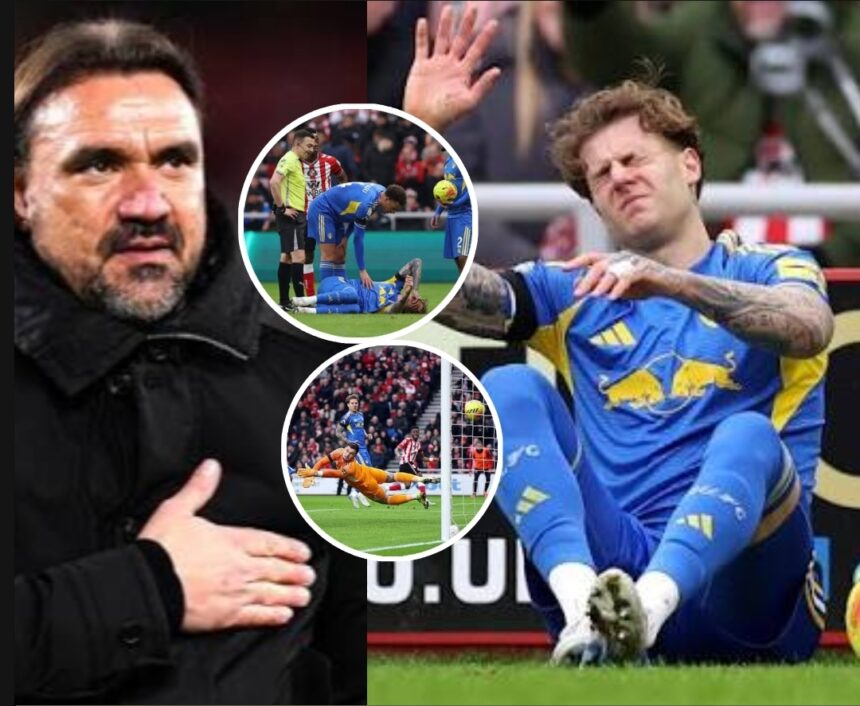
Rodon forced off injured as Farke makes early change that led to Brentford taking the lead
Leeds United’s afternoon at Elland Road took a sharp and damaging turn when centre-back Joe Rodon was forced off injured, prompting Daniel Farke to make an early substitution that ultimately contributed to Brentford seizing the lead. What began as a controlled, competitive contest shifted in character the moment the Welsh international signalled he could not continue, and the visitors capitalised with clinical efficiency.
The incident occurred in the first half, at a stage when the home side still looked organised and purposeful. Rodon had been solid up to that point, dealing with the physical threat of Brentford’s forward line and helping Leeds maintain a compact shape. A seemingly routine challenge or awkward landing left him in clear discomfort. Medical staff attended quickly. After a brief assessment it became obvious he would not be able to play on. Farke had no choice. The change was made.
The identity of the replacement and the timing of the switch mattered. Leeds lost a key aerial presence and a player comfortable in possession under pressure. The reorganisation that followed created a momentary dislocation in the defensive line. Brentford, already probing with purpose, found the space they needed. A swift transition, a well-weighted pass into the channel, and a clinical finish later, the visitors were in front. The goal was not solely the product of the substitution, yet the disruption caused by Rodon’s departure clearly played its part. Defensive cohesion was momentarily broken, communication suffered, and Brentford punished the hesitation.
For Leeds supporters the sequence felt familiar and frustrating. Injuries to important defenders have been a recurring theme in recent seasons, and Rodon’s importance to Farke’s preferred back-three or back-four systems is well documented. The Welshman has grown into a reliable, composed figure at the heart of the defence since arriving on a permanent basis. His ability to step into midfield with the ball, his timing in the air, and his understanding of Farke’s positional demands have made him a near automatic selection. Losing him so early removed both a physical barrier and a tactical reference point.
Farke’s reaction on the touchline was measured but urgent. The German coach is rarely demonstrative, yet the speed with which he organised the change and the instructions he issued to the remaining defenders spoke of concern. The substitute, whether a natural centre-back or a midfielder asked to drop deeper, needed time to adjust to the tempo and the specific threats posed by Brentford’s mobile attackers. That adjustment period proved costly. Brentford’s coaching staff recognised the opportunity immediately. Their players pressed higher, forced hurried clearances, and recycled possession with greater confidence. The goal that followed felt almost inevitable once the initial defensive shape had been unsettled.
The match itself had been evenly poised until the injury. Leeds began with energy, pressing in coordinated waves and looking to exploit the flanks. Early half-chances came and went. A dangerous cross was headed clear, a shot from distance forced a routine save, and the home crowd responded with the familiar noise that Elland Road still produces on big occasions. Brentford, true to their reputation under their own management, stayed compact, looked for transitions, and waited for the moment when Leeds overcommitted. That moment arrived sooner than anyone expected once Rodon left the field.
Tactically the change forced Farke into a rethink. Leeds had started with a clear plan: control the central areas, limit Brentford’s ability to play through the lines, and use the full-backs as overlapping threats. Rodon’s departure disrupted the balance. The remaining centre-backs had to cover more ground. Midfielders dropped deeper to offer protection. The attacking players received less service as the team became more cautious. Brentford sensed the shift and began to dominate territory for a sustained period. Their lead was the logical outcome of that pressure.
Beyond the immediate scoreline, the injury raises longer-term questions for Leeds. Rodon’s availability has been one of the more consistent positives of the campaign so far. When he has played, the defensive record has generally improved. His absence, even if temporary, will test the depth of the squad. Farke has options, yet few of them offer the same combination of physicality, composure and tactical intelligence. The next fixtures will reveal how successfully those alternatives can fill the void.
The goal itself was well taken. Brentford’s forward finished with composure after a neat interchange that exploited the space created by the reorganised Leeds defence. The celebration was understated but significant. For a side that has often found Elland Road a difficult venue, taking the lead against a Leeds team still finding its rhythm carried psychological weight. Leeds now faced the task of chasing the game while short of a key defensive figure, a scenario that places additional strain on the midfield and attacking units.
Farke will be asked about the substitution in the post-match analysis, and his answers will likely emphasise the unavoidable nature of the decision. Managers rarely enjoy making changes forced by injury rather than by tactical preference. The timing made it especially awkward. An early substitution removes a player who has not yet fully settled into the contest and introduces another who must adapt under immediate pressure. In this case the adaptation period was short and the consequence was a goal conceded.
Supporters will debate whether the change could have been managed differently. Some will argue for a like-for-like replacement that maintained the original shape. Others will point to the need for greater defensive solidity once the injury occurred. These conversations are part of the fabric of match days. What is not in dispute is that Rodon’s departure altered the complexion of the afternoon. The team that had looked organised and competitive suddenly looked vulnerable in the moments that followed.
The broader context of the season adds weight to the incident. Leeds have entered the campaign with ambition and a clear identity under Farke. Results have been mixed, performances often encouraging, yet consistency remains the challenge. Defensive solidity has been a foundation of the better displays. Losing a central defender of Rodon’s quality so early in a match against a well-drilled opponent tests that foundation. The response of the remaining players will be scrutinised closely. Character is revealed in such moments as much as quality.
Brentford deserve credit for their ruthlessness. They did not panic when Leeds started brightly. They stayed patient, waited for the disruption, and struck when the opportunity appeared. Their ability to punish structural weaknesses has been a hallmark of their recent seasons. On this occasion the weakness was created by an injury rather than by a tactical error, yet the clinical nature of the finish was pure Brentford. The lead was merited on the balance of the period that followed the substitution.
As the match continued, Leeds attempted to regain control. The home crowd urged them forward. Players who had been asked to cover extra ground began to show signs of fatigue. Farke made further adjustments, seeking a better balance between defensive security and attacking threat. The scoreline remained a problem. Chasing a deficit while missing a key defender is never straightforward, particularly against a side comfortable protecting a lead.
The incident also highlights the physical demands of the modern game. Players are asked to cover significant distances, contest repeated aerial duels, and maintain concentration across ninety minutes. One awkward challenge or unfortunate landing can change the trajectory of an afternoon. Rodon has been durable in recent times, yet no player is immune. The medical team will assess the severity of the injury in the coming hours and days. The club will hope it is not serious enough to keep him out for an extended period.
For Farke the afternoon became a test of problem-solving. The original plan had to be adapted on the fly. Instructions from the technical area increased. Players received clearer guidance on positioning and responsibilities. The response was imperfect but determined. Leeds continued to create moments of threat, yet the absence of Rodon’s presence at the back made every transition more dangerous. Brentford’s lead acted as a constant reminder of the cost of the disruption.
In the stands the mood shifted with the scoreline. Early optimism gave way to anxiety, then to renewed support as the home side pushed for an equaliser. Elland Road retains its capacity to lift a team even when events turn against them. Whether that support would be enough to overcome the deficit remained an open question as the contest developed. What was clear was that the injury to Rodon and the subsequent change had become the defining sequence of the first half.
Looking ahead, the result of this match will form only one data point in a long season. Yet the manner of the goal conceded will linger in the analysis. Teams that concede after forced early substitutions often face questions about squad depth and contingency planning. Farke has spoken previously about the importance of having players ready to step in without a drop in quality. Today that readiness was tested under the most difficult circumstances: an early injury to a key starter against a dangerous opponent.
Rodon’s contribution this season had been steady and largely understated. He is not the type of defender who attracts constant headlines for spectacular interventions. Instead he provides reliability, positional discipline, and an ability to play out from the back that suits Farke’s preferred style. Losing that reliability so early forced others to compensate. Some did so effectively. Others struggled with the sudden increase in responsibility. The collective response will be examined in training in the days that follow.
Brentford’s players and staff will view the goal as validation of their approach. They remained disciplined, waited for the moment of vulnerability, and executed with precision. Their lead was the product of patience as much as quality. For a side that has built a reputation for organisation and efficiency, this was another example of those qualities delivering a tangible reward.
The rest of the match would determine whether Leeds could recover. An equaliser would change the narrative. A second Brentford goal would make the task significantly harder. Either way, the injury to Joe Rodon and the change it forced upon Daniel Farke had already left an imprint on the afternoon. The lead that followed was the clearest evidence of that imprint.
In the wider landscape of the Premier League, such moments are common. Injuries disrupt plans, substitutions create opportunities, and clinical opponents punish the resulting gaps. What made this sequence notable was the combination of factors: the identity of the injured player, the timing of the change, the quality of the opposition, and the immediate consequence on the scoreboard. Leeds will reflect on whether anything more could have been done to mitigate the disruption. Brentford will simply take the three points if they hold on, or the valuable away lead if the contest remains open.
Farke’s post-match comments will be instructive. He is usually measured in his assessments, preferring to focus on the collective rather than individual misfortune. Yet the forced nature of the substitution will be difficult to ignore. The manager will stress the need for the remaining players to step up and for the squad to show resilience. Those messages are standard after setbacks, yet they carry extra weight when a key defender is lost so early.
Supporters leaving the ground, or watching from further afield, will debate the decision-making around the change and the defensive organisation that followed. Some will criticise the speed of adaptation. Others will accept that injuries of this kind are almost impossible to plan for perfectly. The truth likely sits somewhere in between. Leeds were unlucky to lose Rodon. They were then punished for the momentary loss of structure that followed. Both statements can be true at once.
The season is young enough that one difficult afternoon need not define the campaign. Yet the manner of the goal conceded will serve as a reminder of the fine margins involved at this level. A single injury, a single forced change, and a single moment of hesitation can shift the balance of a match. On this occasion those factors aligned against Leeds and in favour of Brentford. The visitors took the lead. The home side were left to chase the game with a reshaped defence and a growing sense of what might have been.
As the final whistle approaches or the second half unfolds, the focus will remain on how Leeds respond. Character is forged in adversity. The players still on the pitch have the opportunity to demonstrate that character. Whether they succeed or fall short, the afternoon will be remembered for the moment Joe Rodon was forced off injured and Daniel Farke was compelled to make an early change that contributed directly to Brentford taking the lead. That sequence, more than any other, defined the contest.
The medical updates on Rodon will be awaited with interest. A short absence would allow Leeds to regroup without major disruption. A longer spell on the sidelines would place greater demands on the rest of the defensive group and potentially force tactical adjustments across multiple matches. Farke has shown flexibility in previous campaigns when faced with similar issues. That flexibility will be required again if the injury proves significant.
In the meantime the scoreboard told its own story. Brentford led. Leeds searched for a way back. The early change forced by injury had set the tone for the remainder of the afternoon. Football matches turn on such moments. This one turned when Joe Rodon could not continue, and Brentford were ready to take full advantage.
The final analysis will note the quality of the goal, the disruption caused by the substitution, and the resilience or lack of it shown by the home side thereafter. For now the headline remains accurate and unavoidable: Rodon was forced off injured, Farke made an early change, and Brentford took the lead as a result. Everything else flowed from that pivotal sequence of events at Elland Road.