
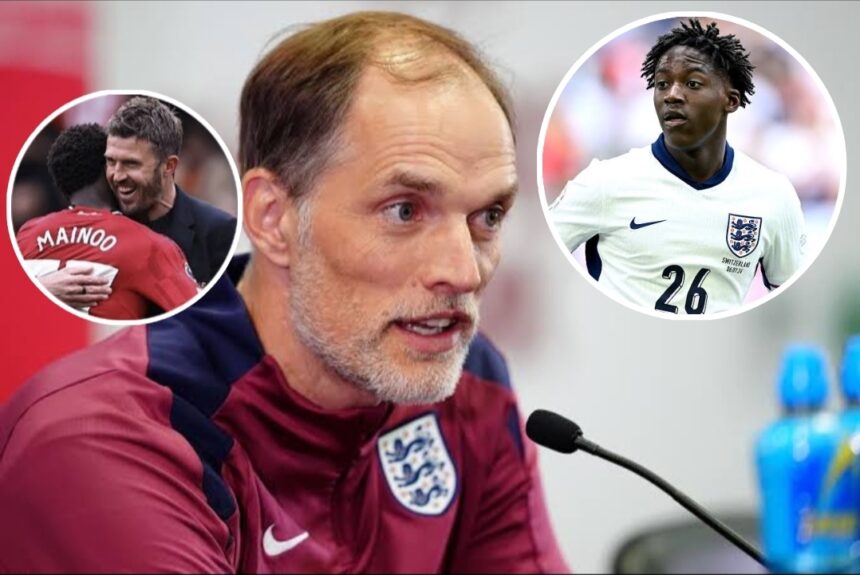
Thomas Tuchel Finally Breaks Silence on Why He Snubbed Kobbie Mainoo at the World Cup After His Champions League Form
In the weeks that followed England’s bronze-medal finish at the 2026 World Cup, one unresolved question lingered louder than most. Why did Thomas Tuchel, the meticulous German coach hired specifically to deliver results on the biggest stage, leave Kobbie Mainoo almost entirely unused? The Manchester United midfielder had forced his way into the 26-man squad on the back of a late-season surge and had produced some of the most eye-catching performances of any English midfielder in the Champions League. Yet when the tournament arrived in the United States, Canada and Mexico, Mainoo watched from the bench. Jordan Henderson, then 36 and recently returned to the Premier League with Brentford, received minutes. Others rotated. Mainoo did not.
For more than a month after the final whistle of the third-place play-off against France, Tuchel had offered only brief, carefully worded responses. He spoke of squad balance, of roles, of the need for specific profiles in specific moments. He never fully addressed the elephant in the room: a young, dynamic, ball-progressive midfielder in strong club form had been frozen out. That silence ended this week.
In a wide-ranging interview conducted at St George’s Park, Tuchel sat down and, for the first time, laid out his thinking in detail. What emerged was not a simple tale of form or favouritism. It was a window into the unforgiving calculations of tournament football, the difference between club excellence and international utility, and the cold reality of a coach who believed the team’s structure mattered more than any individual narrative.
To understand the intensity of the debate, one must first revisit Mainoo’s 2025-26 season. After a difficult period under previous Manchester United management in which starts became scarce, the Stockport-born midfielder rediscovered his rhythm. By the spring he was starting regularly. His performances in the Champions League were particularly striking. Against elite opposition he showed the composure on the ball, the ability to receive under pressure, and the progressive carrying that had first marked him out as a special talent during the 2023-24 campaign.
In the knockout stages he produced moments that travelling United supporters still talk about: a driving run and assist in a tight away tie, a goal from the edge of the box that shifted momentum in a second-leg encounter, and consistent ability to knit midfield and attack together when the game became stretched. Analysts praised his decision-making. Former players noted his improved physicality. By the time Tuchel named his provisional squad, Mainoo had made himself impossible to ignore.
England supporters, many of whom had watched Mainoo light up Wembley in previous youth and senior appearances, expected him to feature. When the final 26 was announced and his name was included, the reaction was largely positive. Here was a player who could offer something different from the established midfield options of Declan Rice, Jude Bellingham, and the more experienced squad members. The narrative wrote itself: the young midfielder who had fought his way back into contention would now get his chance on the biggest stage.
England’s campaign was defined by control, pragmatism and, at times, caution. They topped their group without ever looking entirely fluent. They navigated the knockout rounds with a mixture of individual brilliance—primarily from Harry Kane and Jude Bellingham—and collective defensive organisation. Tuchel’s substitutions were deliberate. When he needed energy or a different profile, he turned to players he trusted in those specific scenarios. Mainoo remained an unused substitute in several matches and saw only limited involvement in others, if any.
The low point for Mainoo’s supporters came in the final group game against Panama. With the result largely secure, Tuchel introduced Jordan Henderson late on. Mainoo stayed on the bench. The decision sparked immediate reaction. Social media filled with frustration. Pundits questioned the logic. Former players suggested that a tournament was the perfect environment to blood a young talent of Mainoo’s quality, especially one who had arrived in form.
Tuchel’s initial public comments were measured. He spoke about the depth of the squad and the need for every player to accept their role. Behind the scenes, according to those close to the camp, the message to Mainoo was consistent: stay ready, the opportunity could still come. It never fully did.
When Tuchel finally addressed the issue at length, he did not hide behind vague generalities. He acknowledged Mainoo’s club performances directly.
“I saw what Kobbie did in the Champions League,” Tuchel said. “Anyone who watches football could see the quality. The way he carries the ball, the composure in tight spaces, the progressive actions—those are high-level traits. He deserved his place in the squad. That was never in question.”
The distinction, he insisted, lay in the specific demands of a World Cup and the particular structure he had built for England.
“In club football you play every three or four days across a long season. You can afford to experiment, to give players extended runs to find rhythm, to accept that some games will be transitional. A World Cup is different. You have a short preparation window. You have a defined group of players who must understand their exact roles in and out of possession. The margins are smaller. One soft moment can end your tournament.”
Tuchel explained that the midfield profiles he prioritised were those that offered maximum defensive security without sacrificing too much progression, or those who could execute specific pressing triggers and positional responsibilities with almost automatic understanding. Rice provided the anchor and the ability to cover large spaces. Bellingham offered the box-to-box dynamism and goal threat. Other options brought experience of managing game states or the ability to play in multiple positions across a back three or four.
“Kobbie’s best work often comes when he has time to receive and then drive,” Tuchel continued. “In the structure we used, especially when we needed to control territory against organised defences or protect leads, we asked for different things. We needed players who could hold their position, who could win the first duel, who could recycle possession quickly under pressure without turning into trouble. Those are skills Kobbie has, but at that moment in his development and in our system, others gave us a higher floor in the scenarios we faced most often.”
He was careful not to criticise Mainoo’s attitude or application. “His training was professional. He was never a problem in the group. The decision was never about character. It was about the eleven and the specific substitutes that gave us the best chance to win the next match in front of us.”
One of the most contentious elements of the tournament was the preference shown at times for Jordan Henderson. The veteran midfielder’s inclusion in the squad had already raised eyebrows. His late introduction ahead of Mainoo intensified the debate.
Tuchel defended the choice without hesitation. “Jordan understands game management at a level that is rare. When you are protecting a lead or trying to close a match out against a side that is throwing numbers forward, experience of those exact moments matters. He has played in World Cups, in Champions League finals, in high-pressure environments for club and country for more than a decade. That knowledge transfers to the players around him. It is not always visible on a highlight reel, but it is real.”
The coach added that Henderson’s ability to occupy space intelligently and communicate defensive organisation gave the team a different kind of security. “Young players can offer electricity. Sometimes what you need is calm and clarity.”
Part of the reason the story refused to die was a set of comments Tuchel made during the tournament about training standards. When asked about squad rotation and unused players, he noted that not every player had hit the levels required in every session. The remarks were widely interpreted as a public critique of Mainoo, even if the midfielder was not named.
In the recent interview Tuchel sought to clarify. “When I speak about training, I am speaking about the collective. There were sessions where the intensity and the detail were not where I wanted them across several players. That is normal in a long tournament with travel and recovery demands. It was never a targeted comment at one individual. If it was received that way, that is unfortunate. Kobbie’s application was not the issue.”
He acknowledged that public comments from a head coach carry weight and can create narratives that are difficult to control. “In this job every sentence is examined. I accept that. My priority was always the team’s preparation for the next opponent.”
Those who spent time around the England squad describe Mainoo as disappointed but professional. He continued to train fully. He supported teammates. He did not create waves. In private conversations with staff he sought clarity on what he needed to improve and how he could force his way into the matchday plans. The answers, according to sources, remained consistent with Tuchel’s public explanation: the system required certain profiles, and those profiles were already filled by players the coach trusted more in the moments that defined matches.
Mainoo’s representatives and those close to him have been measured in their public responses. There has been no public airing of grievances. The midfielder’s focus, they insist, remains on club football and on forcing his way back into the England conversation through performances that become impossible to overlook.
The Mainoo situation sits inside a larger conversation about how England should balance youth development with immediate results. Tuchel was appointed with a clear brief: maximise the chances of winning the World Cup. That brief prioritises the present. It does not always align with the romantic preference for giving emerging talents extended opportunities on the biggest stage.
Supporters of Tuchel’s approach point to the results. England reached the semi-finals, secured bronze, and competed with the best teams in the world. They did so with a clear identity and a high level of organisation. Critics argue that tournaments are also platforms for the next generation and that a player of Mainoo’s talent should have been given the chance to influence games, particularly once qualification from the group was secure or in matches where the result was no longer in doubt.
Tuchel is unapologetic about his priorities. “My job is to win matches and to put the team in the best position to succeed. Every selection is a statement about what I believe gives us the highest probability of a positive result. Popularity is not part of the calculation. Form at club level is important, but it is one input among many. The system, the opponent, the game state, the residual fatigue in the group—these all matter.”
The most important question now is whether the World Cup experience damages Mainoo’s long-term prospects with England. Tuchel’s new contract runs through the 2028 European Championship. The midfielder is still only in his early twenties. Time is on his side.
Tuchel left the door open. “Kobbie is a high-quality player with a big future. The competition for places in this midfield is intense, and that is a good thing for England. If he continues to develop the aspects of his game that translate most directly to our way of working—particularly the defensive side of the role and the ability to execute under the highest pressure—then he will be in the conversation. That is how it works. Performances force decisions.”
For Mainoo, the path forward is clear even if it is demanding. Excel at Manchester United. Add layers to his game that address the concerns raised. Make the next international window impossible to ignore. In modern football, narratives can shift quickly. A strong start to the new season and a run of influential performances can rewrite the story.
Tuchel’s willingness to explain his thinking in detail will not satisfy everyone. Some will continue to see the decision as overly cautious, a missed opportunity to inject youth and dynamism into a side that sometimes struggled for fluidity. Others will respect the coherence of the explanation: a coach who prioritised structure and trusted profiles over sentiment or external pressure.
What the episode reveals most clearly is the nature of elite tournament management. It is not a meritocracy in the simple sense that the player in the best club form automatically starts. It is a constant series of trade-offs under extreme scrutiny. Club form opens the door to the squad. Once inside, the currency changes. It becomes about fit, reliability in specific scenarios, and the coach’s conviction that a particular player raises the team’s floor in the moments that decide matches.
Kobbie Mainoo arrived at the World Cup as one of the more compelling stories in the squad. He left it as one of the more frustrating. Thomas Tuchel has now explained why. Whether that explanation is accepted is another matter. In the unforgiving world of international football, the only verdict that ultimately counts is the one delivered on the pitch in future windows. For Mainoo, the next chapter begins the moment the new club season gathers pace. For Tuchel, the task remains the same: build a team capable of winning when it matters most, even when the decisions required to do so are unpopular.
The silence has been broken. The debate, inevitably, will continue.