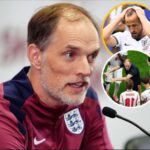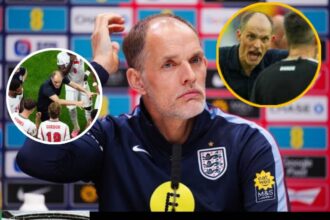


In the tense aftermath of England’s agonising World Cup semi-final exit to Argentina, the Three Lions camp has been defined by silence, reflection and quiet processing of what might have been. That changed dramatically just hours after Thomas Tuchel publicly outlined the first major contours of his plans for Euro 2028. England captain Harry Kane stepped forward as the first senior player to break the collective quiet, delivering a concise five-word message that immediately circulated among supporters and within the football media: “We move forward together now.”
The timing was deliberate. Tuchel, whose contract already runs through the 2028 European Championship co-hosted by England, Scotland, Wales and the Republic of Ireland, had used a post-tournament media appearance to confirm a significant squad evolution. Reports and analysis around his thinking have centred on a “six-man” element of change—essentially a willingness to reopen the door to key talents previously left out of the World Cup squad and to introduce fresh options capable of altering the team’s balance. Kane’s short statement, posted via social media and quickly amplified, was widely interpreted as both an endorsement of the manager and a signal that the dressing room remains aligned behind the German coach despite the painful manner of the Argentina defeat.
England’s World Cup campaign had ended with a familiar mixture of progress and frustration. Reaching the semi-finals represented the nation’s best finish on foreign soil in decades, and the subsequent 6-4 bronze-medal victory over France provided a chaotic, high-scoring reminder of the attacking quality available when the shackles came off. Yet the semi-final itself left lasting questions. Leading through Anthony Gordon’s second-half strike, England switched to a more defensive shape, surrendered control, and ultimately conceded twice late on. Tuchel later insisted the issue was passivity rather than the formation itself, while also accepting responsibility. Fans and some observers were less forgiving. Boos greeted the manager before the third-place match, and debate raged about whether tactical conservatism had again cost England a genuine shot at a first major trophy since 1966.
Against that backdrop, Tuchel’s early signals about Euro 2028 carried extra weight. Multiple reports and analytical pieces have pointed to the need for continuity mixed with selective change. The “six-man” framing that emerged referred to a group of potential recalls and reinforcements: players such as Cole Palmer, Phil Foden and Trent Alexander-Arnold, who had been omitted from the World Cup party for reasons ranging from form and tactical fit to squad dynamics; younger or alternative midfield options to deepen the pool behind Declan Rice; and attacking reinforcements or different profiles who could reduce over-reliance on the same core group. One detailed projection of a possible 2028 squad explicitly listed several of these names alongside established figures, underlining that Tuchel may prioritise rebuilding certain bridges while also promoting the next wave. The manager himself has repeatedly stressed that he remains “100 per cent” invested in the project through the home Euros and that he sees an “extra level” still to be conquered.
Kane’s five-word intervention cut through the noise. As captain, record goalscorer and the most senior voice in the group, his public stance carries unique authority. Throughout the tournament he had already shown loyalty, defending Tuchel after difficult moments and emphasising collective responsibility. In the days after the Argentina loss he spoke of the need to process the disappointment, of the manager learning from his first major tournament in charge, and of the group’s togetherness. The new message—“We move forward together now”—was shorter, sharper and timed precisely after Tuchel’s confirmation of the shake-up. It avoided detailed tactical critique or personal grievance. Instead it projected unity and a shared direction. In an era of constant scrutiny and social-media amplification, five carefully chosen words can sometimes land with more force than a lengthy interview.
The broader context makes the statement significant. Kane will turn 35 shortly after Euro 2028. He has already indicated a desire to continue at the highest level and has refused to rule out involvement beyond that tournament. Yet the reality of ageing and the lack of an obvious long-term successor at centre-forward mean the next two years represent a critical window. Tuchel has built much of the team’s structure around Kane’s intelligence, link-up play and finishing. Any squad evolution must still maximise the captain’s remaining peak years while gradually introducing younger attackers who can share the burden. Kane’s public support for the process suggests he accepts that some faces will change and that the group must adapt without fracturing.
For the players who might return, the environment will be different. Those left out of the World Cup squad experienced the tournament from the outside while England advanced deep into the knockout stages. Reintegration will require professionalism on all sides. Tuchel’s previous selections were often framed around specific roles within a preferred 4-2-3-1, commitment to the “brotherhood,” and the ability to travel and function over a long tournament. The six-man adjustment implied by recent discussion does not necessarily mean wholesale revolution; it points more toward selective restoration of talent and greater depth in areas that looked thin under pressure—particularly creative midfield alternatives and defensive flexibility when key players were unavailable or tiring.
Supporters have mixed feelings. Many remain frustrated by the semi-final collapse and question whether the same management team can deliver the missing final piece. Others note that England under Tuchel produced an unbeaten qualifying campaign, reached the last four of the World Cup, and showed moments of high-quality attacking play. The home advantage of Euro 2028, with matches potentially at Wembley and other familiar venues, offers a different psychological landscape from a long North American campaign. Kane’s message lands as an attempt to close the immediate post-tournament chapter and redirect energy toward the next target.
Behind the scenes, the Football Association has shown no public appetite for change in the dugout. Tuchel’s contract extension earlier in 2026 was designed to provide stability through the Euros. Performance clauses exist, as they do in most modern deals, but the current trajectory keeps the German in place. Kane’s early public alignment reduces the risk of dressing-room leaks or divided narratives that could undermine the reset. Other senior players are expected to follow in the coming days, either with their own statements or through quieter channels. The captain going first sets a tone.
Looking further ahead, the Nations League fixtures later in the cycle will provide the first competitive examination of any revised selection policy. Those matches against high-calibre opposition will allow Tuchel to test combinations, assess the fitness and mentality of returning players, and begin embedding the lessons of the World Cup. Kane has previously spoken about the value of big environments and the need to improve in the decisive moments of major tournaments. The five-word message can be read as the opening note of that longer process: acceptance of the past result, commitment to collective progress, and readiness to adapt the group for the next challenge.
England’s recent history is littered with near-misses and painful exits. The 2026 World Cup added another chapter—progress on the scoreboard of achievement, yet the same familiar sting of falling short when the prize was closest. Tuchel’s willingness to contemplate a six-man element of change acknowledges that continuity alone will not be enough. Kane’s decision to break the silence so quickly, and so succinctly, signals that the captaincy remains focused on the larger goal rather than individual grievances or post-mortems.
Whether “We move forward together now” becomes a lasting slogan or simply a timely intervention remains to be seen. What is already clear is that the England captain has chosen unity and forward momentum at a moment when the squad could have drifted into recrimination. For a team that has repeatedly come close without converting opportunity into silverware, that stance may prove as important as any tactical adjustment Tuchel ultimately makes. Euro 2028 will arrive with home crowds, heightened expectation and a squad that is likely to look somewhat different from the one that left the United States with bronze medals and lingering regret. Kane’s five words suggest the most important constant—leadership from the top of the dressing room—remains firmly in place.
The coming months will test the substance behind the statement. Training camps, Nations League results, and the gradual reintroduction of omitted talent will reveal whether the shake-up produces genuine evolution or merely cosmetic change. For now, the captain has spoken first, briefly and with purpose. In the charged atmosphere that follows a major tournament exit, that itself constitutes a meaningful act of leadership. England’s next chapter has begun, and Harry Kane has made certain the opening line is one of collective resolve.