

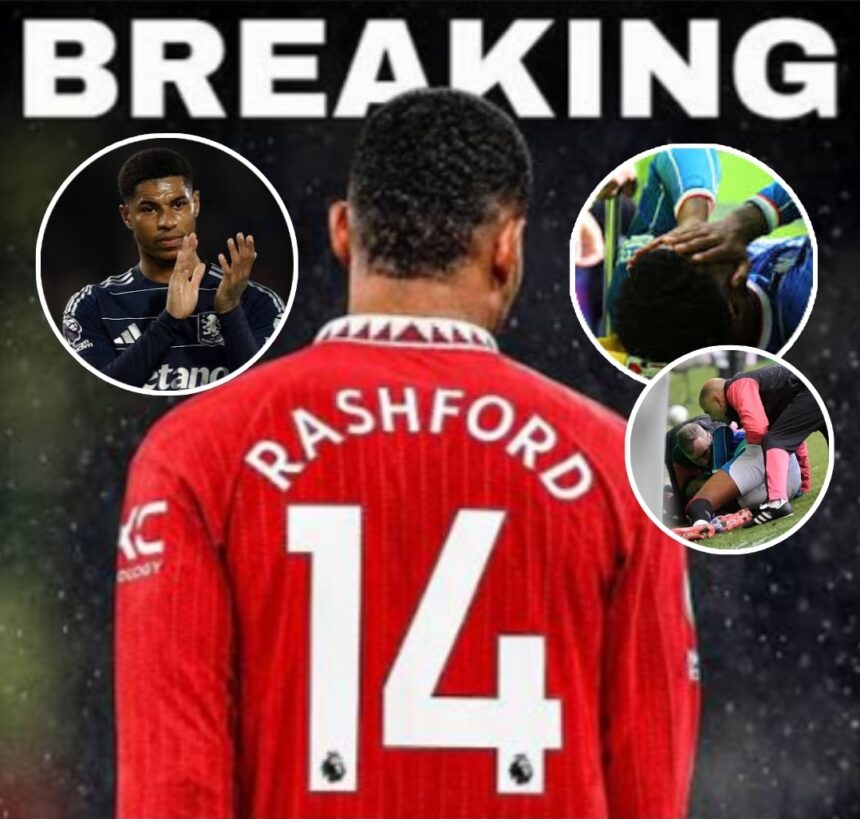
Marcus Rashford Linked with Rangers Move as Youssef Chermiti Ruled Out for the Season with Serious Injury
Rangers have been dealt a significant setback at a crucial stage of the season after striker Youssef Chermiti suffered an ACL injury that is expected to rule him out for an extended period. The club now faces renewed pressure to strengthen its attacking options.
The injury has immediately altered the outlook of Rangers’ transfer planning. Chermiti had become an increasingly important figure within the squad following his arrival from Everton, and his absence leaves manager Derek McInnes with fewer established options in the final third. As a result, speculation has intensified over potential replacements, with Marcus Rashford’s name inevitably attracting attention among supporters.
However, while a move for Rashford would represent one of the most high-profile transfers in Scottish football history, there is currently no credible indication that the Manchester United and England international is set to join Rangers. The most reliable reports suggest Rashford is expected to return to Manchester United following his season-long loan spell at Barcelona.
Even so, Chermiti’s injury has raised an important question for Rangers: how ambitious will the club be in replacing a forward who had become a key attacking option? Chermiti injury leaves Rangers with a major challenge. The timing of his injury could hardly be more difficult for Rangers.
The Portuguese forward sustained the ACL injury during Rangers’ Scottish Premiership defeat to Hibernian. The setback comes after the club had already rejected a significant offer for the striker, with reports indicating strong interest from Galatasaray.
Chermiti’s absence is not simply a loss of squad depth. Rangers made a substantial investment when they signed him from Everton in 2025, with the 21-year-old penning a four-year contract after arriving from the Premier League. He was regarded as a high-potential forward, having developed through Sporting Lisbon’s academy before moving to England.
The injury therefore presents both a sporting and recruitment challenge. Rangers had hoped Chermiti would continue his development into a key attacking asset. Instead, they must now plan without him for the foreseeable future. An ACL injury typically requires a lengthy rehabilitation process, and the club will be cautious about setting any definitive return timeline.
For McInnes, however, the immediate concern is clear: who will provide the goals? Rangers currently have Lawrence Shankland, Bojan Miovski and Ryan Naderi among their recognised attacking options, according to existing reports. While that provides some depth, it may not be sufficient for a club competing domestically while also managing European commitments.
Rangers cannot realistically navigate a demanding season without adequate attacking cover. Chermiti’s injury has therefore increased the urgency around recruitment. The club had already been monitoring forward options, but the situation now makes reinforcement a clear priority. Reports have also linked Rangers with interest in Sheffield United striker Ryan One, although the status of that pursuit remains uncertain.
The broader picture is straightforward: Rangers are in the market for a striker. The question is whether they pursue a pragmatic solution or explore a more ambitious option. This is where a name like Marcus Rashford inevitably enters the conversation. If Rangers were able to secure Rashford’s signature, it would represent a transformative addition to the squad.
The England international has played at the highest level for Manchester United, represented his country at major tournaments, and spent the 2025–26 season on loan at Barcelona. During his spell in Spain, Rashford recorded 14 goals and 14 assists in 49 appearances, according to L’Équipe. Those figures underline that, despite uncertainty surrounding his long-term future at Manchester United, he remains a player capable of delivering at an elite level.
His pace and versatility would also offer Rangers a different attacking dimension. Rashford can operate from the left, through the centre, or in transition-based systems that exploit space behind defensive lines. This flexibility would provide McInnes with valuable tactical options depending on opposition setup.
Against deep-lying teams, his ability to beat defenders in one-on-one situations would be particularly valuable. Against more expansive opponents, his pace in transition could be decisive. From a purely footballing standpoint, Rashford would be a standout addition.
However, there are significant barriers to such a move. Financial realities make a deal highly complex. Rashford remains under contract at Manchester United, and current reporting suggests the club would prefer a permanent transfer rather than another loan arrangement. The Guardian has previously reported that United are actively seeking a resolution to his situation, while also managing the financial implications of his wages.
This immediately complicates any potential move to Rangers. The financial gap between Manchester United and Rangers is substantial. Even if a transfer fee were negotiable, Rashford’s salary would present a major obstacle. A player of his profile, with extensive Premier League and international experience, would have limited financial incentive to move to Scotland without exceptional circumstances.
There are also sporting considerations.
Rashford has recently played for Barcelona and previously spent time at Aston Villa, meaning he has been operating at the highest level of European football. His recent career trajectory suggests he is still capable of competing at elite level. For Rangers to attract him, they would likely need to present a highly compelling sporting and financial package.
As a result, the current speculation should be treated with caution. Manchester United situation adds further uncertainty. Rashford’s future at Manchester United remains one of the more complex transfer situations in European football. After a loan spell at Barcelona, where he made a strong impression, the Spanish club ultimately decided not to pursue a permanent deal, instead prioritising other attacking targets.
Rashford had reportedly been open to remaining in Spain following a productive season. However, with Barcelona opting against a permanent transfer, he now faces a return to Old Trafford. Reports suggest Manchester United are prepared to reintegrate him into the squad under Michael Carrick, while still remaining open to offers. This makes United the most likely immediate destination for Rashford, rather than a move to Scotland.
Unless circumstances change significantly, a transfer to Rangers remains highly speculative. Would Rangers realistically pursue Rashford? There is a clear distinction between theoretical interest and genuine transfer activity.
At present, there is no indication that Rangers are actively pursuing Rashford. Instead, the club appears to be focusing on more realistic attacking targets following Chermiti’s injury. This approach aligns with Rangers’ usual recruitment strategy. The club requires players who can adapt quickly to Scottish football, contribute immediately, and operate within a defined financial structure.
A deal for Rashford would require a fundamentally different financial model, including wages, bonuses, and commercial considerations that extend beyond standard recruitment parameters. It would also raise questions about squad balance and expectations. For these reasons, Rangers are far more likely to target a forward who fits their existing recruitment profile.
Chermiti injury forces strategic reassessment. Despite the uncertainty surrounding Rashford, Chermiti’s injury has undeniably reshaped Rangers’ transfer priorities. Prior to the setback, the club had greater flexibility in assessing its attacking options. Now, reinforcement is essential. The challenge lies in balancing urgency with long-term planning. Rangers will be keen to avoid making a purely reactive signing, but they also cannot afford to leave themselves short in attack.
This is particularly important given the demands of domestic and European competition. Squad depth is critical for sustained success across multiple fronts. From a tactical perspective, Chermiti’s absence leaves a clear gap in Rangers’ attacking structure. The club will likely seek a forward capable of offering mobility, pressing intensity, and a consistent goal threat. Rashford would certainly provide those attributes, particularly in transition-based systems.
His ability to stretch defences and exploit space would make him a unique asset in the Scottish Premiership. He could also operate in multiple attacking roles, offering valuable tactical flexibility. However, these qualities are not exclusive to elite-level players, and Rangers may identify more accessible alternatives with similar characteristics.
Supporters will naturally speculate as It is inevitable that supporters will speculate when a player of Rashford’s profile is mentioned in connection with Rangers. The idea of an England international arriving at Ibrox is understandably appealing and would represent a major statement of intent.
However, it is important to distinguish between speculation and substantiated transfer activity. The confirmed situation is that Chermiti is facing a lengthy spell out with an ACL injury, and Rangers are actively assessing attacking reinforcements.
The Rashford link remains unverified. The priority remains replacing Chermiti for McInnes, the focus is not on marquee names but on functionality.
Rangers require a striker who can contribute goals, lead the line effectively, and remain available throughout a demanding season. Chermiti’s injury removes both depth and long-term potential from the squad. At 21, he was still in a developmental phase, and his absence represents a setback for both player and club.
Rangers will also be mindful of supporting his recovery process, which is expected to be lengthy and carefully managed. At the same time, they must ensure his absence does not derail their competitive objectives.
A defining recruitment decision ahead as Chermiti’s injury has created a clear and immediate challenge for Rangers. The club must now respond decisively in the transfer market. Whether that involves a high-profile signing, a developing prospect, or a short-term solution, the need for reinforcement is undeniable.
Rashford would represent the most ambitious possible outcome, but at present there is no credible indication that such a move is in motion. Instead, Rangers are expected to focus on more realistic targets as they look to address a critical gap in their squad.
What is certain is that Chermiti’s injury has intensified pressure on the club’s recruitment strategy. The next decision made by Rangers could have a significant impact on the remainder of their season.
For now, however, the situation remains clear: Youssef Chermiti is sidelined long-term, Rangers require attacking reinforcements, and Marcus Rashford’s name remains firmly in the realm of speculation rather than confirmed transfer activity.