

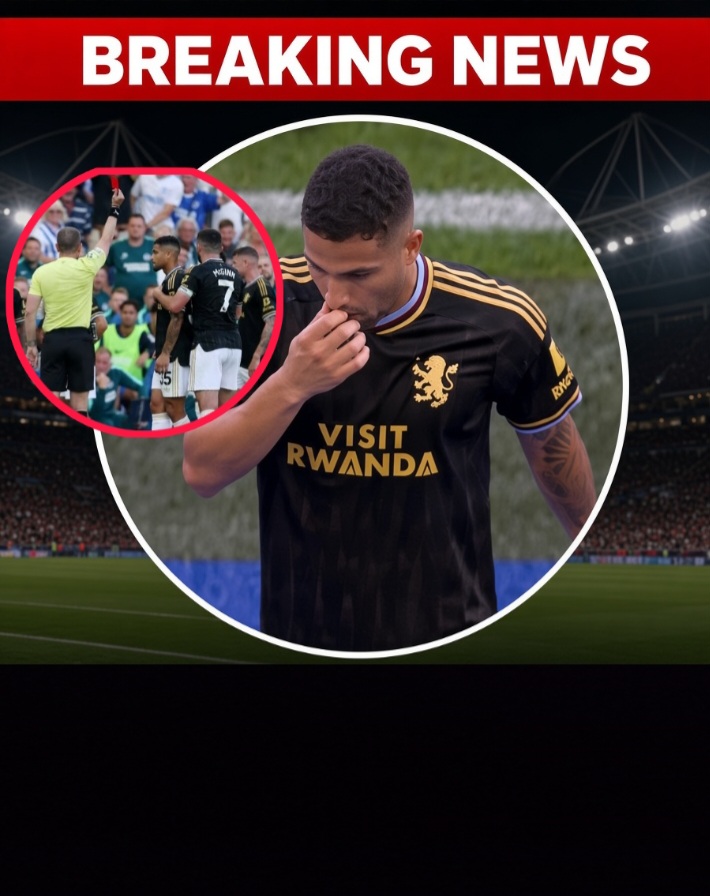
JOÃO GOMES BREAKS SILENCE AFTER RED CARD ON ASTON VILLA DEBUT — HIS RESPONSE HAS FANS TALKING
João Gomes has broken his silence following the red card that turned his Aston Villa debut into a personal nightmare, and the Brazilian midfielder’s lengthy, reflective response has already generated widespread discussion among supporters of both Villa and his former club Wolverhampton Wanderers.
The 25-year-old was sent off in the 40th minute of Sunday’s 4-0 Premier League defeat at Brighton & Hove Albion after a moment of frustration that ended his first competitive appearance in claret and blue almost before it had properly begun. Villa were already four goals behind when Gomes, having been dispossessed by Georginio Rutter, kicked out while on the ground. VAR intervened, the referee reviewed the incident on the pitchside monitor, and a straight red card for violent conduct was shown. The dismissal left Unai Emery’s side with ten men for the remainder of a chastening afternoon and ensured Gomes will serve a multi-match suspension that rules him out of the next three Premier League fixtures, including the home clash with Arsenal.
In the hours after the final whistle, speculation grew about how the high-profile summer signing would address the incident. On Monday, Gomes issued a detailed personal statement that has been widely shared and debated. The tone is contrite, self-critical and forward-looking. It does not attempt to minimise the seriousness of the red card or shift blame. Instead it confronts the moment directly and places it within the wider context of his move to Villa and his ambitions at the club.
“I want to start by saying clearly that I am sorry,” Gomes began. “Sorry to my new teammates, to the manager, to the staff, and most of all to the Aston Villa supporters who came to support us and had to watch that performance and that moment from me. A debut is something you dream about. You imagine scoring, or controlling the midfield, or helping the team win. What happened on Sunday was the opposite of every dream I had about wearing this shirt for the first time in the Premier League.
“The red card was my responsibility. There is no excuse. I was on the ground, I was frustrated, and I reacted in a way that is not acceptable. In football you are allowed to feel emotion. You are allowed to be competitive. You are not allowed to kick out at an opponent like that. I know the rules. I have played enough games at a high level to understand the difference between a hard challenge and a moment of madness. What I did crossed the line. The referee and VAR got it right. I have to accept the suspension and use the time to reflect properly.
“I also want to speak about the rest of my performance because the red card did not happen in isolation. From the first minutes I did not feel myself. My timing was off. My decisions were rushed. I gave the ball away in a dangerous area and Brighton scored. That moment hurt me, and instead of resetting and focusing on the next action, I let the frustration build. By the time the incident with Rutter happened, I was already in a bad place mentally. That is on me. A professional footballer has to control his emotions even when the game is going against him. Especially when the game is going against him.
“I came to Aston Villa because I believed in the project. I believed in Unai Emery. I believed that this was a club that could help me take the next step in my career. The supporters have been fantastic since the day the transfer was announced. I felt the expectation and I welcomed it. To let everyone down on the very first day is something that will stay with me. I cannot change what happened at the Amex. What I can do is make sure it never happens again and that the next time I pull on this shirt I show the real version of myself.
“Some people will say this is just one game. Others will say it is a sign of something deeper. I understand both reactions. From my side, I know who I am as a player. I know the intensity I can bring, the distances I can cover, the duels I can win, and the way I can help a team control matches. None of that was visible on Sunday. That is the most disappointing part for me. The red card is the headline, but the bigger issue is that I did not help my team when they needed me. In a game that was already slipping away, I made it worse.
“I have spoken with the manager. The conversation was honest. He did not need to raise his voice. The look in his eyes was enough. He expects standards every single day, and on Sunday I fell well below those standards. I have also spoken with senior players in the squad. Their message has been consistent: accept it, learn from it, and come back stronger. That is exactly what I intend to do.
“The suspension means I will miss important matches. That is part of the punishment and I accept it completely. While I am unavailable I will work harder than ever in training. I will study the game again. I will make sure that when I return I am physically and mentally ready to contribute in the way the club needs. I do not want sympathy. I want the opportunity to put things right on the pitch.
“To the Villa fans specifically, I want to say this: I know the history of this club. I know what it means to wear the claret and blue. I know the expectations that come with a big transfer fee. I did not come here to become a story for the wrong reasons. I came here to win matches, to compete at the top end of the table, and to make the supporters proud. Sunday was a failure against every one of those aims. I will carry that failure with me, not as a weight that drags me down, but as a reminder of the standards I must meet every time I represent this club.
“There will be people who write me off after one afternoon. That is normal in football. I cannot control the noise. What I can control is my response. The only response that matters is the one that happens on the training pitch and then, when the suspension is over, on the match pitch. I will not hide. I will not make excuses. I will work.
“I also want to thank those who have sent messages of support. Professional football can be lonely when things go wrong, and it means a lot to know that some people are willing to look beyond a single bad day. At the same time, I understand the anger and the disappointment. Both reactions are valid. My job now is to earn back the trust that was given to me when I signed.
“Moving from Wolves to Villa was a big step. I leave Molineux with respect for everything I experienced there and with gratitude for the opportunity the club gave me. At Villa I have found a new challenge and a new responsibility. The first chapter of that story was painful. The rest of the book is still unwritten. I intend to make sure the following chapters look very different.
“Finally, I want to apologise once more to everyone connected with Aston Villa. The players who had to play more than half a match with ten men because of my action. The manager whose plans were disrupted. The supporters who paid good money and travelled to support the team. You deserved better from me. I will do everything in my power to make sure that the next time you see me in a Villa shirt, you see a player who has learned, who is focused, and who is ready to fight for this club in the right way.
“Thank you for listening. Now the only thing left is to work.”
The statement, released through the player’s representatives and quickly amplified across social media, has prompted a wide range of reactions. Many Villa supporters have welcomed the directness and the absence of self-pity. In an era when athletes sometimes offer vague or defensive comments after controversy, Gomes’ willingness to accept full responsibility and to address the collective nature of the failure has been noted positively. Others remain sceptical, arguing that words are easy and that only sustained performances over coming months will repair the damage of such a high-profile debut disaster.
Pundits have also weighed in. Some have praised the maturity of the response while cautioning that the real test will come when Gomes returns from suspension and faces the scrutiny that inevitably follows a moment like this. Former players have spoken about the difficulty of controlling emotion when a debut is unravelling in real time, while emphasising that elite footballers are paid precisely to manage those emotions.
From a footballing perspective, the red card and the statement sit within a larger narrative for Aston Villa. The defeat at Brighton raised questions about the team’s readiness for the new season and about the integration of new signings. Emery is not a manager known for public excuses, and the early evidence suggests he will demand a rapid improvement. Gomes’ absence through suspension removes one option from the midfield and places greater responsibility on the players who remain available.
For Gomes himself, the coming weeks will be spent on the training ground rather than the pitch. The suspension provides time for reflection but also risks allowing doubt to grow if not handled carefully. His statement suggests he understands that risk. By confronting the incident so openly, he has at least taken ownership of the story rather than allowing others to define it for him.
Whether the response ultimately satisfies supporters will depend on what follows. A strong return to the side, consistent performances, and visible commitment to the collective cause would transform the narrative from one of debut disaster to one of redemption. Failure to do so would leave the red card as a defining early image of his Villa career.
For the moment, João Gomes has spoken at length and without evasion. He has apologised, accepted the consequences, and promised to work. In the unforgiving environment of the Premier League, that is only the beginning. The real conversation will continue every time he steps onto the pitch after his suspension ends. Fans will be watching closely to see whether the words issued in the aftermath of a painful debut are matched by actions that help Aston Villa move forward.