

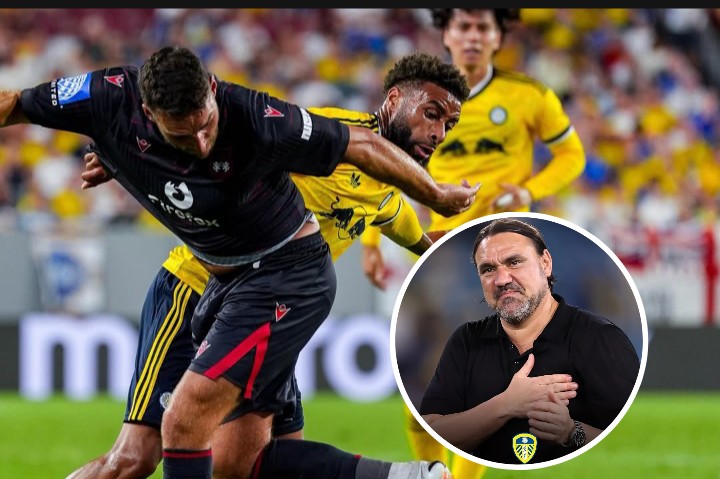
Daniel Farke did not hold back. Standing in front of the media in the humid Florida evening, the Leeds United manager delivered one of the most pointed public criticisms of a player during his time at Elland Road. The occasion was a 3-2 pre-season defeat to Wrexham at Raymond James Stadium in Tampa, a result that would ordinarily have been filed under “useful workout” and forgotten. Instead it became the backdrop for a remarkable dressing-down of one of the club’s high-profile stars, a player Farke suggested should seriously consider his future elsewhere if standards do not improve immediately.
The German coach’s words were measured in tone yet devastating in content. After acknowledging the early stage of pre-season and the value of competitive minutes, Farke turned his attention to the individual whose errors and attitude had, in his view, contributed decisively to the loss. “I will not name names in every sentence because this is still a squad matter,” he said, “but everyone in that dressing room knows who I am talking about. The performance was not acceptable. The application was not acceptable. If a player of that profile cannot deliver the basics required at this club, then perhaps he needs to look for a different environment where the expectations match what he is prepared to give.”
The remark landed like a hammer. In modern football managers rarely issue such open invitations for a player to leave, especially in the first friendly of the summer. Yet Farke has never been one for empty diplomacy when he senses a threat to the collective standards he has spent years building. The defeat itself was chaotic and entertaining in the way pre-season matches often are. Wrexham, already several matches into their own preparations and buoyed by a recent win over Manchester United, started brightly and took an early lead. Leeds responded with two goals either side of half-time to go in front, only for defensive lapses and a late Wrexham surge to turn the scoreline around. The decisive moments, according to those present, repeatedly involved the same Leeds player: a misplaced pass that invited pressure, a failure to track a runner, a soft challenge that gifted possession, and a visible drop in intensity as the temperature and the scoreline rose.
Supporters watching on late-night streams and those who had made the trip to Florida reacted with a mixture of shock and grim recognition. Social media filled with the same observation from every corner of the Leeds fanbase: Farke had finally said out loud what many had been muttering for months. The star in question has polarised opinion for some time. Capable of moments of genuine quality, he has also been accused of drifting through matches, of lacking the consistent aggression demanded by a club still establishing itself back in the Premier League, and of failing to match the work-rate of less celebrated teammates. Previous public defences from Farke had been interpreted by some as protection. Saturday’s comments marked a clear change of approach.
The context of the fixture makes the manager’s outburst even more striking. This was Leeds’ first outing of the summer. Several senior players were still building fitness after the previous campaign and, in some cases, international tournaments. Rotation was expected. Mistakes were inevitable. Yet Farke has long maintained that pre-season is precisely the time when standards must be non-negotiable. “We do not have the luxury of soft months,” he has said in the past. “Every session, every friendly, every decision sets the tone for what follows.” By calling out a senior figure so publicly, he has drawn a line that the rest of the squad cannot ignore.
Wrexham, for their part, will take considerable satisfaction from the result. Phil Parkinson’s side have used their American tour to test themselves against higher-level opposition, and a victory over a Premier League club — even a rotated one — carries symbolic value. Their goals came from well-worked moves and a clinical edge that Leeds could not match in the closing stages. The Welsh club’s organisation and intensity exposed the gaps that Farke will now demand be closed before the more serious tests against Sunderland and Liverpool later in the tour.
Inside the Leeds camp the fallout is likely to be carefully managed. Farke is known for his detailed individual feedback and for protecting players from external noise once the cameras are off. Yet the public nature of these comments changes the dynamic. The player now faces a choice: respond with the kind of performances that silence the criticism, or accept that his position in the squad is under genuine threat. Transfer speculation, never far away in the modern game, will intensify. Clubs monitoring the situation will have taken note of a manager effectively placing one of his own players on the market through attitude rather than ability.
For Leeds United the episode arrives at a delicate moment in their trajectory. Having secured Premier League status last season with a respectable points total and an FA Cup semi-final run, the club enters the new campaign with heightened expectations. Investment has been made. New faces have arrived. The demand for consistency is greater than ever. Farke’s willingness to confront a star so early suggests he believes the margin for passengers has disappeared. In previous years he might have absorbed individual shortcomings for the sake of squad harmony. On this evidence he is no longer prepared to do so.
The wider reaction among the support has been largely supportive of the manager. Many fans have long argued that certain high-earning or high-profile individuals have been afforded too much leeway. The sight of Farke refusing to paper over the cracks has been interpreted as a sign of strength rather than panic. “About time,” was a common response across fan forums and social platforms. Others urged caution, noting that public criticism can sometimes backfire and create unnecessary tension in the dressing room. Both perspectives will be tested in the coming weeks as the squad continues its work in the United States and then returns to England for further friendlies.
Farke’s record shows he is capable of extracting strong performances from players who respond to pressure. It also shows he is prepared to move on those who do not. The coming days will reveal how the targeted player chooses to react. A strong showing in the next match would go a long way toward repairing the relationship. Continued underperformance would likely accelerate discussions about a permanent exit. Either way, the manager has made his position unmistakable.
Pre-season is traditionally a time for gradual improvement, for fitness and for experimentation. It is rarely the stage for open confrontations. That Farke chose this moment, after a 3-2 defeat to Wrexham, to issue such a stark message underlines the seriousness with which he views the situation. Standards at Leeds United under his leadership have always been exacting. On Saturday night in Tampa those standards were publicly restated, and one of the club’s stars was left in no doubt about the consequences of failing to meet them.
The football world will watch the next chapter with interest. Managers who speak so directly about their own players invite scrutiny of both the individual and the environment that produced the criticism. For Daniel Farke the calculation appears clear: short-term discomfort is preferable to long-term acceptance of mediocrity. Whether the player at the centre of the storm can meet the challenge, or whether he will indeed seek a new club, remains to be seen. What is already certain is that the conversation at Leeds United has shifted, and the man in charge has set the terms.
In the hours after the final whistle, as the stadium emptied and the squad returned to their hotel, the focus remained fixed on those post-match comments. A 3-2 scoreline in July can be explained away as part of the process. A manager telling a star he should consider his future cannot. Daniel Farke has drawn a line. The rest of the summer will determine who steps over it and who is left behind.