
Michael Carrick Could Be In Trouble As FA Set To Investigate Him Over Controversial Comment In The Manchester Debby
In a stunning development that has sent shockwaves through the world of football, Manchester United interim manager Michael Carrick finds himself at the centre of an escalating storm after the FA confirmed it is preparing to open a formal investigation into remarks he made in the aftermath of the recent Manchester Derby. The governing body of English football has reportedly received multiple formal complaints and is now examining whether Carrick’s post-match comments crossed the line into misconduct that could bring the game into disrepute.
Sources close to the FA’s disciplinary department have indicated that the process is already underway, with preliminary reviews of video footage, transcripts, and social media reaction expected to conclude within days. If the investigation proceeds to a full charge, Carrick could face anything from a fine and touchline ban to a more severe sanction that would further destabilise an already turbulent period at Old Trafford.
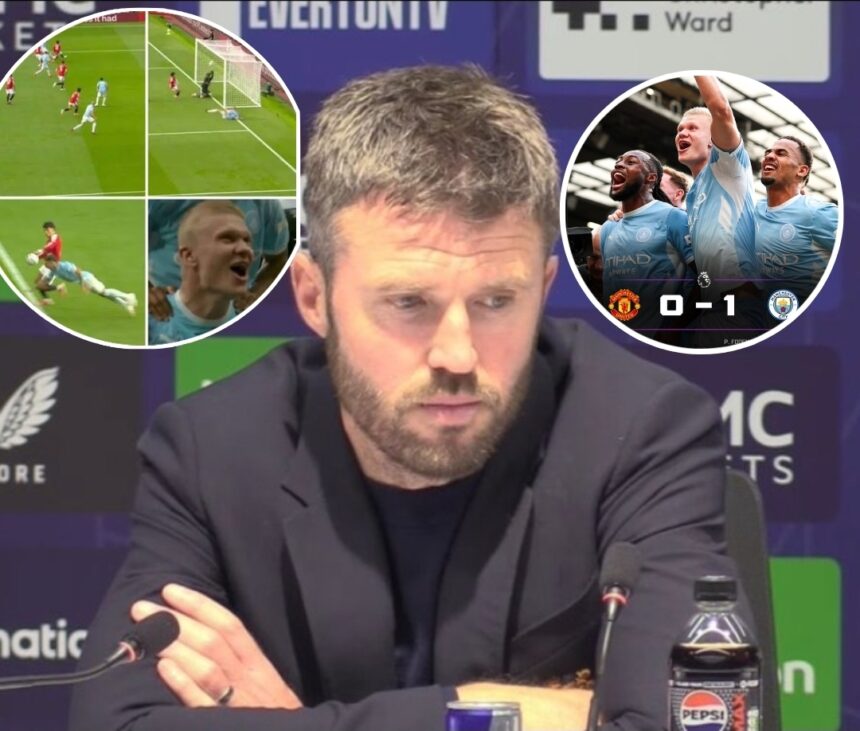
The controversy stems from comments Carrick made during his post-match press conference following Manchester United’s narrow 1-0 defeat to Manchester City at Old Trafford. With the scoreline still raw and emotions running high after a contentious refereeing decision that allowed Erling Haaland’s goal to stand, Carrick delivered a pointed critique that many observers immediately labelled as going beyond the usual bounds of managerial frustration.
According to multiple journalists present in the room, Carrick stated: “What we witnessed today wasn’t just a bad decision. It felt like the entire system was tilted. When you’ve got that many screens, that many officials, and they still can’t see what’s in front of them, you start to wonder who the game is really protecting. Some clubs seem to get the benefit every single time in this fixture. It’s not a coincidence anymore.”
The remarks, delivered in a calm but unmistakably cutting tone, were interpreted by some as an accusation of systemic bias favouring Manchester City in the Manchester Derby. Within minutes of the press conference concluding, clips began circulating widely on social media. Supporters of both clubs, rival managers, and even neutral observers quickly weighed in. What began as a heated reaction to a single match rapidly escalated into a broader debate about respect for officials, the integrity of the Premier League, and the responsibilities of high-profile managers.
The FA’s interest reportedly intensified after formal complaints were lodged by several clubs and a number of match officials’ organisations. One senior figure within the English refereeing community is said to have described the comments as “a direct attack on the credibility of the entire officiating framework.” Another complaint, originating from a Premier League club, allegedly argued that Carrick’s language risked undermining confidence in the sport’s domestic governance structures.
Insiders familiar with the FA’s internal processes note that the organisation has become increasingly sensitive to public statements that question the fairness of major competitions or imply institutional favouritism. While clubs and managers usually handle such matters through their own channels, the high profile of the Manchester Derby—watched by millions—and the involvement of high-profile players appear to have elevated the case within the FA’s disciplinary system.
Carrick, who only recently stepped into the interim role at Manchester United following the departure of Ruben Amorim, has built a reputation over the years as a measured and thoughtful figure. As a player he was known for composure in midfield rather than controversy. His transition into management at Middlesbrough and then back to Old Trafford had been marked by a similar restraint. That history makes the current situation all the more surprising to many within the game.
Yet the pressure of the Manchester Derby has a long tradition of producing moments that spiral beyond the pitch. The fixture has generated tunnel confrontations, pointed press conference exchanges, and lingering grudges that sometimes last seasons. In this latest chapter, the combination of a contentious goal, a red card to Phil Foden, and United’s inability to convert numerical advantage into a result created a perfect storm of frustration. Carrick’s decision to channel that frustration into language that questioned the broader integrity of decisions appears to have been the tipping point.
Manchester United themselves have so far remained largely silent. Club sources indicate that officials are monitoring the situation closely and have already sought legal advice. There is concern inside Old Trafford that an extended investigation could distract from the team’s efforts to stabilise results and climb the table. Some senior figures are said to believe the comments, while poorly judged, do not warrant FA intervention and should have remained an internal club matter.
Across the city, Manchester City have declined to comment officially. Privately, however, several voices associated with the club have expressed satisfaction that the issue is being taken seriously. One former City player turned pundit remarked on a late-night radio show that “managers have to be careful what they say when the eyes of the country are watching. You can’t just throw accusations around and expect nothing to happen.”
The potential consequences for Carrick are significant. The FA’s disciplinary code contains provisions covering conduct that brings the game into disrepute, public statements that undermine the authority of officials, and any behaviour that damages the image of football. Past cases involving managers who questioned the integrity of refereeing or competition fairness have resulted in multi-match bans, substantial fines, and, in rarer instances, longer suspensions from football-related activity.
Legal experts specialising in sports law suggest that Carrick’s defence would likely centre on the heat of the moment and the specific context of a single match decision. They note that managers routinely criticise officials without facing formal scrutiny. The distinguishing factor in this case, according to those familiar with the FA’s thinking, appears to be the implication of repeated, systemic favouritism rather than a one-off error.
Social media reaction has been predictably polarised. United supporters have largely rallied behind their manager, arguing that he was simply voicing what many fans have felt for years about decisions in the Derby. City fans and neutral observers have been more critical, accusing Carrick of sour grapes and of attempting to deflect attention from his team’s failure to score despite playing against ten men for a significant period.
Pundits have also divided. Some former players who experienced the intensity of the fixture themselves have defended Carrick’s right to speak passionately. Others have argued that modern managers must exercise greater restraint precisely because every word is amplified instantly across the country. One prominent television analyst observed that “the line between legitimate criticism and damaging the game’s reputation has become thinner than ever. Carrick may have stepped over it.”
The timing could hardly be more awkward for Manchester United. The club is still navigating a transitional period, with questions about the permanent managerial position unresolved and results remaining inconsistent. An investigation hanging over the head of the interim boss adds another layer of uncertainty at a moment when stability is desperately needed.
The FA has not yet issued a public statement confirming the investigation, in keeping with its usual practice of remaining silent until formal charges are brought or a decision is reached. However, multiple independent sources in England have corroborated that preliminary work is already in progress. A decision on whether to proceed to a full disciplinary hearing is expected within the next two weeks.
If charges are formally laid, Carrick would be given the opportunity to respond in writing and, if necessary, appear before a disciplinary panel. The process can take weeks or even months, during which the manager would remain free to continue his duties unless an interim suspension is imposed—an outcome considered unlikely at this stage but not impossible.
Beyond the immediate personal and professional implications for Carrick, the episode raises broader questions about the boundaries of free speech for managers in the modern game. In an era of constant media scrutiny, social media amplification, and national audiences, the margin for error in post-match comments has narrowed considerably. What might once have been dismissed as a heated reaction in a local press conference can now trigger serious consequences within hours.
The Manchester Derby has always been more than just a football match. It is a cultural event that reflects the deep rivalry between two of England’s most storied clubs and their passionate supporter bases. Decisions on the pitch, comments off it, and the narratives that form around them carry weight far beyond ninety minutes. In this instance, a single press conference appearance has the potential to overshadow the remainder of the season for one of the participants.
Carrick’s career trajectory has been defined by intelligence and understatement. From his days as a composed midfielder under Sir Alex Ferguson to his careful rebuilding work at Middlesbrough and his unexpected return to Old Trafford, he has rarely been associated with controversy. That makes the current situation all the more remarkable. Whether the investigation ultimately results in sanctions or is quietly closed, the damage to his carefully cultivated image may already have been done.
Supporters of stronger accountability for public statements argue that football cannot afford to tolerate language that plants seeds of doubt about the fairness of its competitions. Critics of the FA’s approach counter that the organisation is overreaching and risking a chilling effect on managers who feel genuine grievances about officiating standards.
As the football world waits for the next development, one thing is already clear: the fallout from this Manchester Derby will extend well beyond the final whistle. Michael Carrick, a man who spent much of his playing career avoiding the spotlight, now finds himself firmly in its glare for reasons he could scarcely have anticipated when he walked into the press conference room on that Sunday afternoon.
The coming days and weeks will determine whether this episode becomes a footnote in a long career or a defining and damaging chapter. For now, the investigation looms, the speculation continues, and the football community remains divided over where legitimate frustration ends and unacceptable commentary begins.
In the high-stakes environment of the Premier League and the national stage on which its biggest fixtures are played, words carry consequences. Michael Carrick is discovering just how heavy those consequences can be.